

December 9, 2025
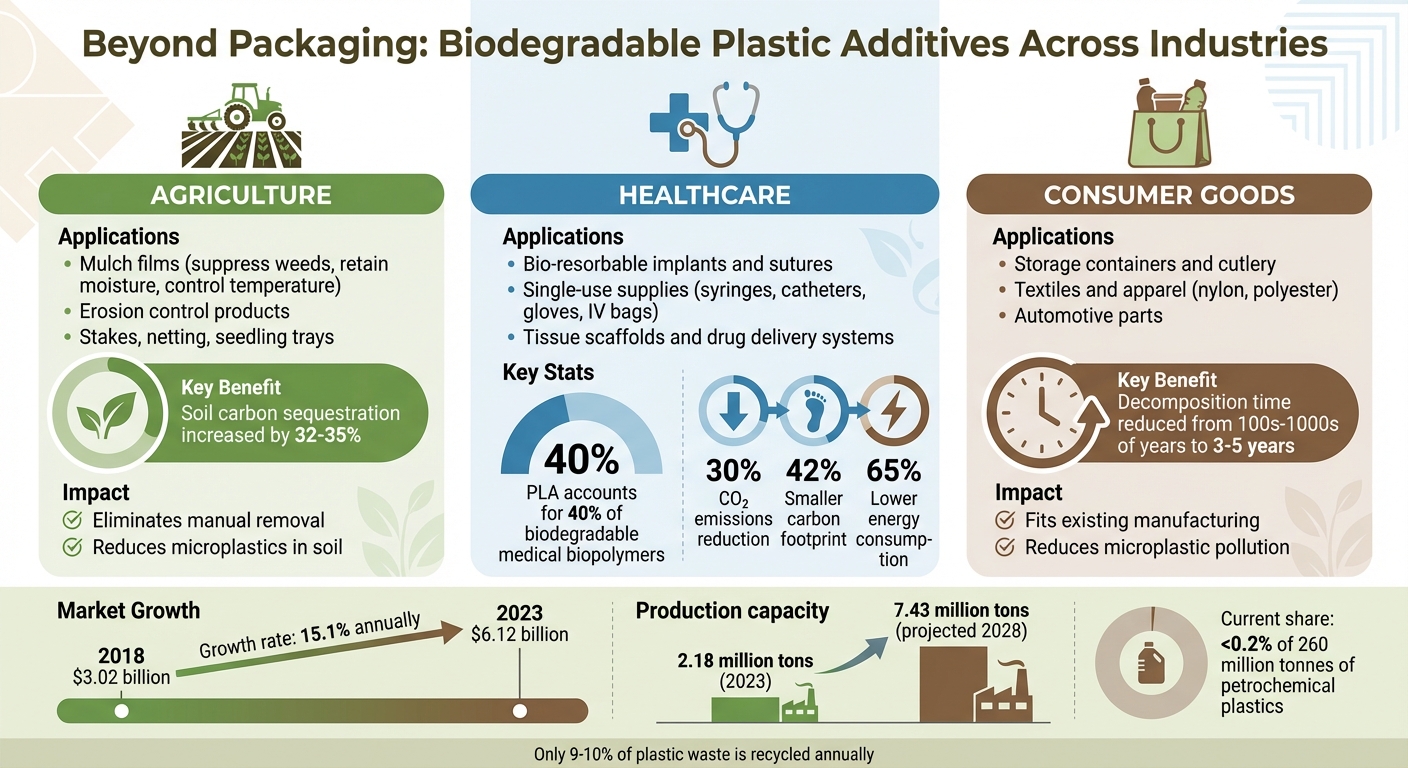
Biodegradable plastic additives are transforming industries beyond packaging. These additives help plastics break down faster and more safely, reducing waste and pollution. Here’s a quick summary of their applications:
These innovations align with growing regulations in the U.S., requiring careful material selection, testing, and compliance with labeling laws. While biodegradable plastics currently account for a small fraction of global production, their adoption is accelerating due to their ability to reduce environmental impact, cost, and waste.
Biodegradable Plastic Additives Applications Across Industries

Farmers in the U.S. are grappling with a persistent issue: plastic waste left behind in fields after each growing season. Traditional polyethylene films require manual removal, which is both labor-intensive and costly. Enter biodegradable plastic additives - these materials are changing the game by allowing agricultural plastics to break down naturally in the soil. This not only eliminates the need for removal but also helps maintain healthier crops.
One of the standout uses of biodegradable additives in agriculture is in mulch films. These films serve multiple purposes: they suppress weeds, control pests, retain soil moisture, regulate temperature, and minimize erosion throughout the growing season. The best part? After the harvest, these films can be tilled directly into the soil, where they degrade naturally, unlike traditional plastic films that need to be removed and sent to landfills.
This shift offers farmers a double benefit - saving time and cutting costs by eliminating the need for labor-intensive removal and disposal.
Biodegradable additives are also making waves in other soil contact products, such as stakes, netting, seedling trays, and erosion control materials. These products naturally break down over time, removing the hassle of retrieval and disposal.
The environmental perks go even further. Biodegradable materials help reduce the buildup of microplastics and nanoplastics in the soil - an issue that can harm plants, disrupt beneficial soil microbes, and even infiltrate the food chain. Plus, as these materials break down, they contribute to soil health by increasing organic carbon levels and improving fertility. Some studies suggest they can boost soil carbon sequestration by as much as 32–35%. Compare this to nonbiodegradable plastics, which can linger in the soil for centuries, gradually degrading its quality.
The adoption of biodegradable additives isn’t just about convenience - it’s a step forward for sustainable farming. These materials align with the principles of regenerative agriculture, a movement gaining momentum across the U.S. By reducing long-term plastic pollution, they protect essential soil ecosystems. During the degradation process, beneficial microorganisms thrive, leading to improved soil structure and better water retention.
However, there’s a regulatory gray area. Currently, no federal standards exist to govern biodegradable or compostable agricultural products, which can cause confusion. Farmers should ensure that the products they use fully biodegrade into CO₂ and microbial biomass rather than breaking down into microplastics. For instance, oxo-degradable plastics, which fragment into smaller pieces without fully biodegrading, fail to meet both American and European standards for true biodegradability.
The use of non-biodegradable plastics in medical devices has long posed a waste management challenge, as these materials can linger in the environment for decades, if not centuries. Enter biodegradable plastic additives: a step toward reducing this environmental burden while ensuring that medical products remain safe and effective throughout their use.
Biodegradable additives are reshaping the way medical devices are designed, particularly for implants, sutures, and tissue scaffolds. These materials are engineered to break down naturally within the body, eliminating the need for surgical removal while maintaining their intended functionality.
Take polylactic acid (PLA), for instance. This material now accounts for 40% of biodegradable medical biopolymers, with production doubling to 60,000 tons over the past five years. Similarly, polyhydroxyalkanoates (PHA) production has grown sixfold, reaching around 10,000 tons. These biopolymers are crucial for advanced applications like sutures, bone screws, and drug delivery systems, where precise control over degradation rates is essential for clinical success.
Globally, bioplastics production capacity hit 2.18 million tons in 2023 and is projected to soar to approximately 7.43 million tons by 2028. However, regulatory hurdles, including rigorous testing, often delay market entry. Beyond implants, biodegradable materials are also being used to improve the safety and sustainability of single-use medical supplies.
Single-use medical products - such as syringes, catheters, gloves, and IV bags - are notorious for contributing to environmental waste due to their reliance on conventional plastics. By integrating biodegradable additives, these items can meet sterility requirements while breaking down more easily after disposal.
PLA, valued for its biocompatibility and biodegradability, is increasingly used in products like syringes and catheters. Other biodegradable polymers, such as poly(lactic-co-glycolic acid) (PLGA) and PHA, are also making their way into applications like wound dressings and medical device packaging. These materials offer environmental benefits, including a reduction in carbon dioxide emissions by at least 30%, a 42% smaller carbon footprint, and 65% lower energy consumption compared to traditional plastics.
Despite these advancements, meeting U.S. regulatory and safety standards remains a critical step. Biodegradable medical plastics must undergo stringent biocompatibility testing and maintain sterility throughout their shelf life. There are also concerns about the potential for some biodegradable plastics to degrade into microplastics more quickly than conventional materials, which could pose risks to ecosystems and human health. Additionally, the potential leaching of additives - especially when exposed to heat or repeated use - requires ongoing monitoring and thorough testing.
Biodegradable additives are changing the game when it comes to reducing plastic waste in everyday household products. Items like storage containers, cutlery, and electronics housings are now designed to last during use but break down much faster after disposal. These additives can shrink the decomposition timeline from hundreds or even thousands of years to just 3–5 years in environments rich with microbes. The best part? They fit right into existing manufacturing setups without requiring major changes and align with standard recycling systems. Beyond household items, this technology is also making its way into textiles and automotive parts.
Synthetic fibers such as nylon and polyester are major contributors to microplastic pollution, shedding tiny particles during washing and lingering in the environment for centuries. By adding biodegradable compounds to these materials, manufacturers are tackling this issue head-on. These additives allow the fibers to naturally break down at the end of their lifecycle without compromising their strength or durability during use. The process integrates smoothly into current production methods, and advanced formulations shorten polymer chains, making it easier for microorganisms to turn the material into harmless byproducts.
In the automotive world, biodegradable plastic additives are helping manufacturers create parts that balance performance with sustainability. Lightweight components not only improve fuel efficiency and cut CO2 emissions but also simplify waste management through better composting and recycling options. These innovations are designed to deliver the mechanical strength and thermal stability needed to handle the extreme range of U.S. driving conditions - from scorching Arizona summers to freezing Midwest winters.
Selecting the right biodegradable additive begins with understanding the type of plastic resin you're working with and the intended end-of-life scenario for your product. The additive must be compatible with your resin - whether it's PET, HDPE, LDPE, PP, EVA, nylons, or polycarbonate - and tailored to the product's disposal environment. For instance, a product designed for an aerobic landfill will require a different additive formulation than one meant for marine environments, composting facilities, or open-air degradation. These additives can be seamlessly integrated into existing manufacturing systems without requiring expensive changes. Once materials are chosen and processed correctly, the next step is thorough testing to confirm biodegradation performance.
Backing up biodegradation claims requires rigorous testing through accredited methods. True biodegradation happens when microorganisms break down the polymer's carbon backbone into natural byproducts like carbon dioxide, methane, water, and biomass - not just fragmented particles. It's essential to select testing protocols that match the product's real-world disposal conditions. For items marketed as compostable, ASTM D6400 and D6868 are the key standards in the U.S., and testing must be conducted at accredited labs to ensure both regulatory and consumer trust. Once biodegradation performance is validated, all claims must align with U.S. regulatory standards.
In the U.S., using the term "biodegradable" for single-use products is heavily restricted. Instead, focus on substantiated "compostable" claims supported by third-party certifications. States like Washington have strict rules under the Plastic Product Degradability Act, which prohibits terms like "biodegradable", "degradable", or "decomposable" for most products, with a rare exception for biodegradable agricultural mulch films. Similar restrictions exist in California, Maryland, and Minnesota. To meet these requirements, obtain third-party certification from organizations like the Biodegradable Product Institute (BPI), which verifies compliance with ASTM standards.
Washington State also enforces specific labeling rules. Products must include a third-party certifier's logo, use a designated color (green, beige, or brown), and clearly display the word "compostable" directly on the product. Additionally, the FTC Green Guides require industrially compostable products to include a disclaimer like "Local facilities may not exist". Responsibility for compliance lies with the producer, whether it's the manufacturer or the brand licensee.
"The term 'biodegradable' is accurate when used in technical contexts, but is highly problematic and even illegal to use in sales and marketing language for single-use products, including those certified and marketed as 'compostable'." - BPI
Biodegradable plastic additives are proving their worth far beyond just packaging applications. From agricultural mulch films that reduce microplastic pollution in soil to bio-resorbable medical devices designed to break down into harmless byproducts, these additives are cutting waste and emissions while helping companies meet strict U.S. environmental regulations.
The market growth tells the story. Though biodegradable plastics currently make up less than 0.2% of the 260 million tonnes of petrochemical plastics produced annually, their market value has grown significantly - from $3.02 billion in 2018 to an estimated $6.12 billion by 2023, reflecting an annual growth rate of 15.1%. This surge is largely driven by increasing regulatory pressure and the urgent need to address environmental challenges, especially considering that only about 9–10% of plastic waste is recycled each year.
These additives are paving the way for what experts describe as a "new and sustainable plastics economy", where products fulfill their purpose and then degrade into harmless byproducts like carbon dioxide and water. In agriculture, they help reduce fertilizer waste and enhance transplant success rates. In healthcare, they mitigate the environmental impact of disposable items like medical gowns and masks. In consumer goods, they replace synthetic microplastics in cosmetics, which are increasingly subject to regulatory bans.
For successful adoption, manufacturers must carefully consider material compatibility, conduct rigorous testing through certified methods, and adhere to state-specific labeling laws. The tools, technology, and regulatory guidelines are already in place. The next step is integrating these additives into production processes, ensuring products perform effectively and degrade safely. For U.S. manufacturers, biodegradable additives offer a practical path toward sustainability, building on the innovations discussed throughout this guide.
Biodegradable plastic additives are transforming agriculture by addressing the challenge of plastic waste. These additives help materials like mulch films break down faster after use, reducing the buildup of plastic waste and limiting microplastic pollution. This quicker decomposition process not only lessens the environmental burden but also protects soil health by avoiding the accumulation of harmful residues.
By speeding up the breakdown of plastics, these additives support farming practices that are both productive and environmentally conscious, offering farmers a practical way to care for the planet while maintaining efficiency.
Biodegradable plastics in healthcare come with a unique set of challenges that can affect their performance and practicality. For starters, these materials are highly sensitive during manufacturing, requiring carefully controlled conditions to preserve their integrity. Even slight deviations can compromise the quality of the final product.
Another major concern is their reaction to common sterilization techniques. Processes like high heat or radiation, often used to ensure medical-grade cleanliness, can speed up the degradation of these plastics. This raises questions about their reliability and durability in medical settings.
On top of that, biodegradable plastics often have a shorter shelf life. They can start to break down over time, sometimes even before they are put to use. Overcoming these obstacles is essential to fully harness the potential of biodegradable plastics in healthcare, ensuring they remain safe and effective for medical applications.
Biodegradable additives are mixed directly into plastic resins or polymers during manufacturing. The best part? This process doesn't require any modifications to the equipment already in use. These additives are compatible with widely-used plastics like HDPE, LDPE, PET, and polypropylene.
Once incorporated, these additives stay dormant until the product ends up in a microbe-rich environment, such as a landfill. At that point, they kick into action, accelerating the natural biodegradation process. What used to take centuries can now happen in just 3–5 years - all without affecting the product's strength or shelf life.