
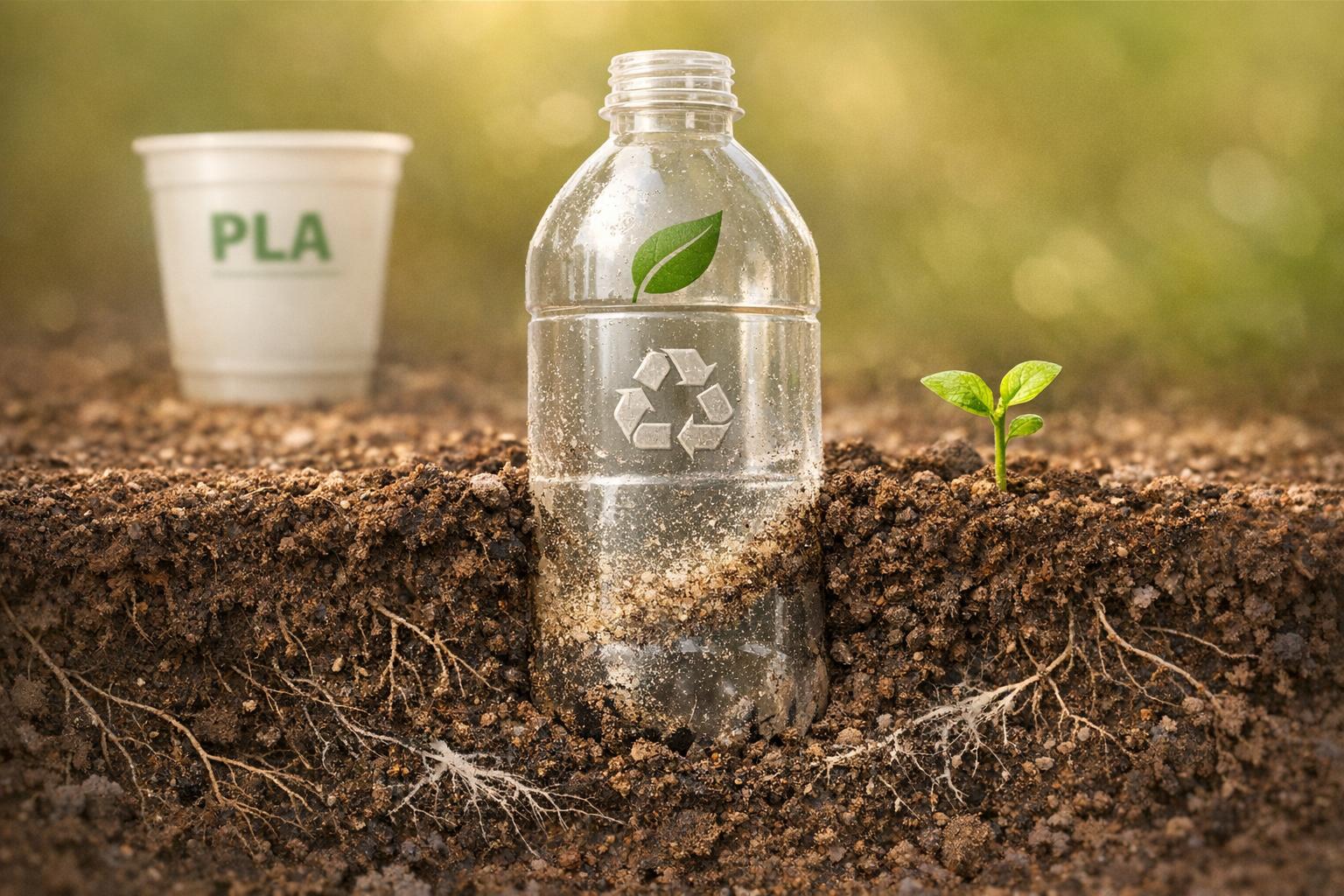
PLA (Polylactic Acid) is often marketed as an eco-friendly plastic alternative, but it has critical flaws:
- Biodegradation Issues: PLA only breaks down in industrial composting facilities at high temperatures (136°F–140°F). In landfills, oceans, or home compost bins, it can persist for decades, often fragmenting into microplastics.
- Weak Performance: PLA is brittle, with poor heat resistance (softens at 131°F–149°F), making it unsuitable for many applications like hot-fill containers or automotive parts.
- High Costs & Recycling Challenges: PLA production is up to 10 times more expensive than traditional plastics. It also contaminates recycling streams and degrades in quality after just one recycling cycle.
BioFuture Additives solve these issues by enabling conventional plastics (like PET, PE, and PP) to biodegrade in common environments (landfills, oceans, soil) while maintaining their strength, heat resistance, and recyclability. These additives are cost-effective (only ~10% increase in material costs) and integrate seamlessly into existing manufacturing systems, offering a practical alternative to PLA.
Quick Comparison
| Feature | PLA | BioFuture Additives |
|---|---|---|
| Biodegradation | Industrial composting only | Landfills, oceans, soil, composting |
| Degradation Timeframe | Decades in most environments | Starts within 14 days |
| Heat Resistance | Low (131°F–149°F) | Maintains base polymer stability |
| Mechanical Strength | Brittle | Retains original polymer properties |
| Recyclability | Limited; contaminates streams | Fully compatible |
| Cost Impact | ~200% increase in raw materials | ~10% increase in raw materials |
| Production Setup | Requires specific settings | No retooling needed |
BioFuture Additives address PLA’s limitations, offering a practical, efficient, and cost-effective solution for plastic biodegradation.

PLA vs BioFuture Additives: Complete Performance Comparison
The Problems with PLA: Where It Falls Short
PLA, often seen as an eco-friendly alternative to traditional plastics, has several shortcomings that challenge its reputation. Its limitations span environmental impact, physical performance, and economic feasibility, raising questions about its sustainability.
PLA Doesn’t Break Down in Most Environments
While marketed as biodegradable, PLA’s breakdown process requires very specific conditions – namely, the sustained high temperatures (136°F–140°F) found in industrial composting facilities. Outside of these facilities, PLA struggles to degrade. For instance, in environments like landfills, oceans, or home compost bins, the temperatures and conditions remain far too mild. A study testing PLA in freshwater and seawater at 75°F (25°C) over 400 days found no signs of degradation. In soil or home composting setups, full breakdown could take as long as 30 years.
Adding to the problem is PLA’s hydrophobic nature, which slows water absorption. Instead of fully breaking down, it fragments into microplastics, further polluting ecosystems.
"PLA and its blends are similar to non-biodegradable plastics in terms of biodegradation in aquatic environment." – Environmental Chemistry Letters
| Environment | Temperature | Degradation Outcome |
|---|---|---|
| Industrial Compost | 136°F – 140°F | ~90% degradation in 70–90 days |
| Marine/Aquatic | Ambient (<77°F) | Negligible degradation; fragments into microplastics |
| Landfill | Ambient/Variable | Persists for decades |
| Soil/Home Compost | Ambient | Full biodegradation may take up to 30 years |
PLA’s environmental challenges are compounded by its performance issues, particularly under heat or mechanical stress.
Poor Heat Resistance and Brittleness
PLA’s physical properties limit its use in many applications. With a low glass transition temperature (131°F–149°F), it softens under relatively mild heat, making it unsuitable for products like hot-fill containers, microwaveable packaging, or automotive parts. Its brittleness, with an elongation at break of less than 10%, increases the likelihood of stress fractures.
Moisture exposure also accelerates hydrolysis, weakening PLA’s molecular structure and reducing its strength. Under sustained loads, components like clips or fasteners can lose their integrity, making PLA impractical for demanding applications.
"PLA is a very brittle material with less than 10% elongation at break." – Advanced Drug Delivery Reviews
Beyond its environmental and physical drawbacks, PLA’s economic and recycling challenges further hinder its adoption.
Production Costs and Recycling Incompatibility
From a cost perspective, PLA is far from competitive with conventional plastics. Its production costs are 2–10 times higher, with prices ranging from $1.60 to $2.30 per kilogram, compared to about $1.00 per kilogram for polyethylene. Additionally, PLA relies on feedstocks like corn and sugarcane, which often require intensive farming practices. These practices can lead to deforestation, water contamination, and soil degradation.
Recycling PLA presents another major hurdle. Despite its visual similarity to PET, PLA’s lower melting temperature can compromise the quality of recycled plastic batches. Even small amounts – exceeding just 1% – can contaminate polyester waste streams, undermining recycling efforts that already manage to capture only 5–6% of plastics. Mechanical recycling of PLA also causes significant degradation. After just one recycling cycle, its molecular weight drops by 5.5%, while its Melt Flow Index rises from 6.55 g/10 min to 9.93 g/10 min, signaling chain scission and reduced polymer quality.
"Our research shows that PLA is not the panacea for the planet’s plastic problems. Whilst PLA is derived from renewable resources… its production and end-of-life disposal pose environmental issues which should not be overlooked." – Sarah Edwards, Head of North America, Eunomia
How BioFuture Additives Solve These Problems
BioFuture Additives tackle the main challenges of PLA by improving conventional plastics. These additives seamlessly integrate with widely-used polymers like polyethylene (PE), polypropylene (PP), and polyethylene terephthalate (PET), enabling biodegradation in everyday environments without sacrificing performance. This balance forms the backbone of their practical solutions.
Breaks Down in Multiple Environments
PLA often requires the controlled heat of industrial composting facilities to break down. In contrast, BioFuture Additives allow plastics to biodegrade in a variety of microbe-rich environments, such as landfills, oceans, soil, and composting systems – places where plastic waste typically ends up. The additives activate the biodegradation process only when exposed to these conditions, ensuring the plastic remains stable during production and use. Once disposed of, the plastic undergoes a transformation, breaking down into carbon dioxide, water, and biomass that reintegrates into natural ecosystems. This process not only accelerates degradation but also preserves the original performance of the plastic.
Maintains Strength and Works with Existing Systems
BioFuture Additives ensure that the treated plastics retain their original physical and mechanical properties. Unlike PLA, which becomes brittle and loses strength under mild heat, plastics enhanced with these additives maintain durability, heat resistance, and strength – even at elevated temperatures. For example, PLA can start to deform at temperatures around 130°F (53°C), while additive-treated plastics remain stable. Another advantage is that manufacturers can use the additives without needing to modify their existing equipment or production processes. Plus, the treated plastics are fully compatible with both mechanical and chemical recycling systems.
"BFA does not change the physical characteristics of treated plastic." – BioFuture Additives
Supports Carbon Neutrality and Reduces Crop Dependence
By using conventional polymers, BioFuture Additives eliminate the need to divert food crops for plastic production, unlike PLA, which relies on agricultural resources. This approach also keeps costs manageable, increasing raw material expenses by only about 10%, compared to PLA’s hefty 200% premium. Additionally, the bioconversion process helps support carbon neutrality by breaking down plastic waste into elements that naturally cycle back into the environment. This provides a regenerative solution for the large amount of plastic that escapes recycling and ends up in landfills or oceans.
sbb-itb-7985ceb
PLA vs. BioFuture Additives: A Direct Comparison
When evaluating plastic alternatives, it’s essential to look beyond the surface. PLA, often promoted as an eco-friendly solution, has limitations that make it less practical for many applications. BioFuture Additives tackle these issues head-on, addressing the shortcomings of PLA while offering a more versatile and efficient solution. Here’s a closer look at how these two options stack up.
The most striking difference lies in biodegradation. PLA can take decades – up to 30 years – to break down in home compost or soil. Even in marine environments, its degradation rate is comparable to traditional petroleum-based plastics like PET. On the other hand, BioFuture Additives activate enzyme colony formation within just 14 days, enabling biodegradation across a wide range of environments.
Temperature resistance is another key factor. PLA’s low heat deflection (53–56°C) makes it unsuitable for high-temperature applications and contributes to its brittleness. In contrast, BioFuture Additives maintain the original strength and thermal stability of the base polymer, whether it’s PE, PP, or PET.
Comparison Table: PLA vs. BioFuture Additives
| Feature | Polylactic Acid (PLA) | BioFuture Additives |
|---|---|---|
| Base Material | Niche bioplastic | Mainstream polymers (PET, PE, PP) |
| Biodegradation Environment | Industrial composting only (>60°C / >140°F) | Landfills, oceans, soil, and composting |
| Degradation Timeframe | Decades in soil/landfill; 11 days in industrial | Enzyme colony formation starts in 14 days |
| Heat Resistance | Low (53–56°C max) | Maintains the base polymer’s thermal stability |
| Mechanical Strength | Brittle; low impact resistance | Preserves the original polymer strength |
| Recyclability | Incompatible with PET/PP recycling streams | Fully compatible with existing recycling systems |
| Production Cost Impact | ~200% increase in raw materials | ~10% increase in raw materials |
| Processing Requirements | Requires specific settings; prone to clogging | No retooling required; standard processing suffices |
| Marine Environment | Fragments into microplastics | Mineralizes into biomass, CO₂, and water |
In terms of cost, BioFuture Additives offer a clear advantage. While PLA increases raw material costs by approximately 200%, BioFuture Additives result in only a modest ~10% increase. Even better, they integrate seamlessly into existing manufacturing processes, avoiding the need for costly retooling.
From biodegradation performance to recyclability and cost efficiency, BioFuture Additives present a compelling alternative to PLA, making them a practical choice for a wide range of applications.
Conclusion: Why BioFuture Additives Are the Better Choice
PLA has its challenges – its brittleness and the need for specific high-temperature conditions for degradation are widely recognized. Without industrial composting facilities operating above 131°F, PLA can linger in landfills or soil for decades, which undermines its recyclability and environmental benefits. Clearly, a more adaptable and effective solution is needed.
BioFuture Additives offer that solution. These additives enable biodegradation in a variety of environments, including landfills, oceans, soil, and composting facilities – precisely where waste tends to accumulate. What’s more, they retain the original properties of mainstream plastics like PET, PE, and PP, such as strength, heat resistance, and shelf life, addressing PLA’s shortcomings. With only a 1% addition to the masterbatch, they can be seamlessly integrated into existing manufacturing processes without requiring any changes.
But the benefits go beyond just improved degradation. BioFuture Additives also contribute to environmental goals like carbon neutrality by reducing reliance on food crops and large-scale monoculture farming. They work in harmony with both mechanical and chemical recycling systems, ensuring that materials can be efficiently recycled or, if discarded into the environment, fully break down into biomass, water, and CO₂ – leaving no microplastic traces behind. Studies from Eunomia Research & Consulting highlight that while PLA’s sustainability hinges on the availability of industrial composting facilities (which are not widespread), BioFuture Additives deliver genuine degradation across multiple environments.
FAQs
How do BioFuture Additives help plastics break down in different environments?
BioFuture Additives help plastics break down faster by introducing special biodegradable compounds that become active in microbe-rich environments like landfills, composting sites, and even the ocean. These compounds make the plastic easier for microorganisms to digest, turning it into natural byproducts such as water, carbon dioxide, and biomass.
What’s impressive is that these additives are designed to keep plastics strong and durable during their regular use. However, once exposed to microbes, the decomposition process kicks in efficiently. They work with various plastics, including PETG, nylons, and polyolefins, offering a way to cut down on long-lasting waste and microplastic pollution while aligning with environmental goals.
How does the cost of using BioFuture Additives compare to PLA?
Using BioFuture Additives can help cut costs compared to standard PLA, particularly when looking at the bigger picture. While PLA is biodegradable, it has some notable drawbacks – like being brittle and having low impact strength. These issues often mean additional expenses from product failures or extra processing steps.
BioFuture Additives address these weaknesses by boosting PLA’s durability, performance, and degradation efficiency. This reduces the need for costly modifications or replacements. While the upfront cost of these additives might be slightly higher, they can lead to long-term savings by cutting down on waste, lowering regulatory compliance costs, and allowing for more sustainable production without requiring significant equipment changes. Over time, the improved performance and reduced expenses make this a smart financial decision.
How do BioFuture Additives improve the durability and heat resistance of bioplastics like PLA?
BioFuture Additives are designed to boost the durability and heat resistance of bioplastics, such as PLA, by fortifying the polymer’s structure. These biodegradable additives are crafted to tackle common challenges like brittleness and limited durability, enhancing the material’s toughness, flexibility, and ability to endure higher temperatures.
By reinforcing the polymer matrix, these additives help bioplastics maintain their performance during use while still breaking down effectively in appropriate conditions. This makes it possible for manufacturers to produce environmentally friendly plastics that align with both performance needs and sustainability objectives.