

December 11, 2025
Biodegradable plastic additives are reshaping manufacturing by making plastics decompose faster, cutting waste, and reducing emissions. Here's what you need to know:
Biodegradable additives are a practical way for manufacturers to meet growing demand for eco-friendly products while staying ahead of regulations. Learn how to incorporate these additives into your processes and reduce your environmental impact effectively.
Conventional vs Biodegradable Plastic Additives: Key Differences and Environmental Impact
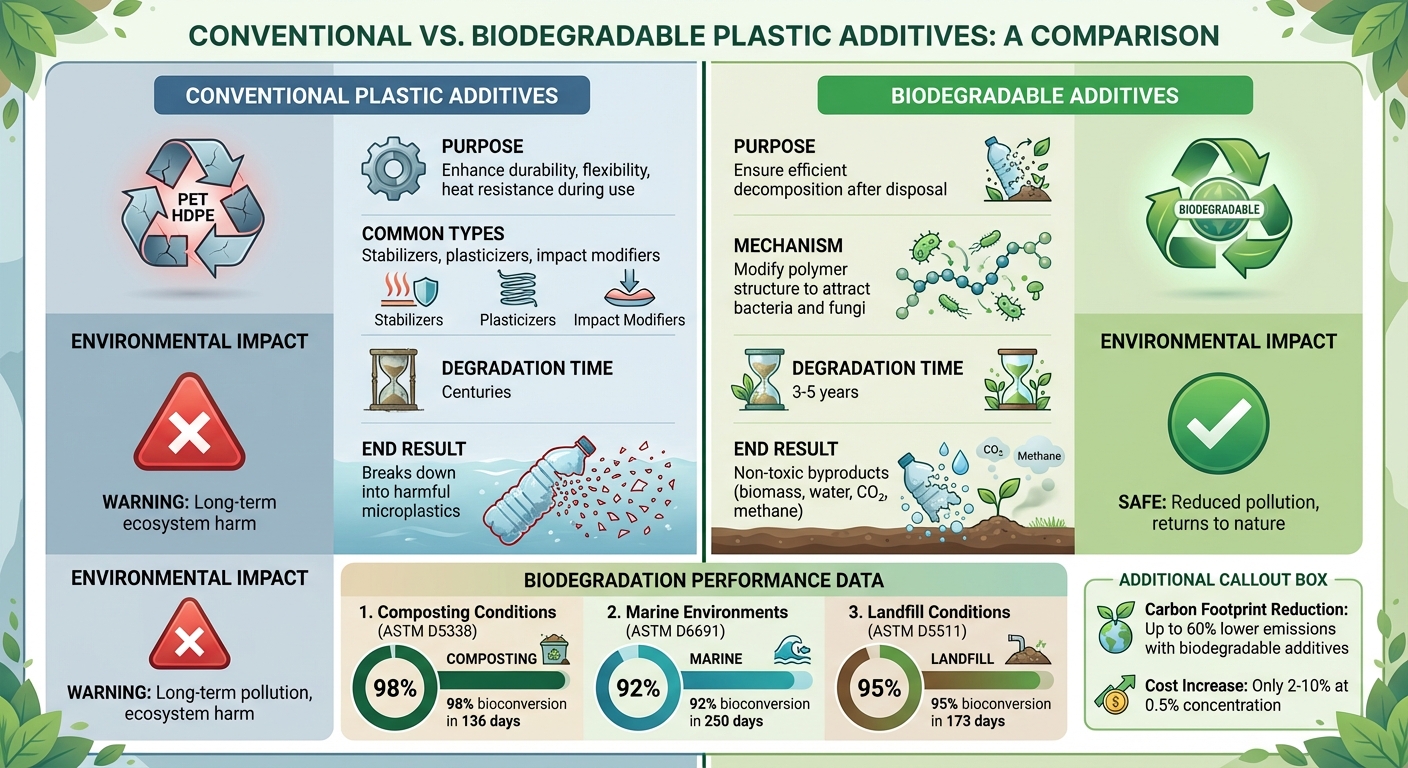
Biodegradable additives are designed to kickstart the breakdown of plastics after they're discarded. Unlike traditional additives, which focus on enhancing a plastic's properties during use, these additives are all about ensuring plastics decompose efficiently at the end of their lifecycle.
Conventional plastic additives - like stabilizers, plasticizers, and impact modifiers - are added to improve things like durability, flexibility, and heat resistance. The downside? Plastics with these additives can stick around for centuries, often breaking down into harmful microplastics.
Biodegradable additives, on the other hand, work by tweaking the polymer structure to attract bacteria and fungi that naturally occur in the environment. These microbes release enzymes that break the chemical bonds in the plastic, causing it to degrade both physically and chemically. The process doesn’t stop there - microorganisms metabolize the plastic, turning it into non-toxic byproducts like biomass, water, carbon dioxide, and methane. For instance, BioFuture's additives are designed to activate only in environments rich with microbes, ensuring the plastic remains stable during use.
A critical step in this process is reducing the length of polymer chains through hydrolysis. This makes the plastic more vulnerable to microbial activity. Scientists have even identified specific bacteria capable of breaking down common plastics like polyethylene, polypropylene, and polyvinyl chloride. Additionally, "smart" additives are now being developed to react to triggers like temperature, moisture, or UV light, further improving how plastics degrade once disposed of.
Biodegradable additives come in various forms - pellets, liquids, or powders - and are made using bio-based, starch-based, or plant-fiber formulations. These additives are designed to maintain the plastic's durability and shelf life while ensuring decomposition begins only after disposal.
Polymers like Polylactic Acid (PLA) and Polyhydroxyalkanoates (PHA) are particularly well-suited for these additives. For example, PLA breaks down effectively at temperatures above 140°F (60°C), while PHA is recognized for its ability to biodegrade even in marine environments.
In the U.S., tailoring biodegradable additives to specific disposal conditions is key to achieving environmental and regulatory goals. Factors like temperature, moisture, and microbial activity play a big role in how effectively these additives work. Key biodegradation environments include industrial composting facilities, home composting setups, landfills, and marine ecosystems.
Industrial composting facilities, with their high temperatures and active microbial communities, are ideal for breaking down materials like PLA and PHA quickly. However, the limited availability of such facilities in many areas poses challenges. Home composting, which operates at lower temperatures, typically results in slower degradation. Landfills and marine environments present entirely different conditions, requiring additives that are engineered to respond to specific triggers like moisture, UV exposure, or temperature changes to ensure effective breakdown in these settings.
Biodegradable additives play a crucial role in helping manufacturers meet sustainability goals without sacrificing product quality. Here’s a closer look at the main types of these additives and their unique applications.
Pro-additives are specially designed to modify the chemical structure of traditional plastics, making them more susceptible to microbial degradation. These additives are compatible with a variety of polymers, such as PET, PE, PP, PS, PVC, and PLA, as well as synthetic textiles like polyester and nylon.
One of their standout features is their ability to integrate seamlessly into existing manufacturing setups, including processes like extrusion, blow molding, injection molding, and rotomolding. No new equipment or retooling is required. Even at a low concentration of 0.5%, these additives only increase raw material costs by 2–10%, while delivering impressive results. For example, under composting conditions (ASTM D5338), they achieve up to 98% bioconversion within 136 days. In marine environments (ASTM D6691), they reach 92% bioconversion within 250 days, and in landfill conditions (ASTM 5511), 95% bioconversion is achieved within 173 days.
Bio-based plasticizers and starch-based additives focus on replacing fossil fuel-derived materials with renewable resources such as corn, sugarcane, or agricultural waste. This not only reduces the carbon footprint of plastic products but also often makes them compostable or marine-degradable. For instance, producing polylactic acid (PLA) generates 50% less greenhouse gas emissions compared to traditional plastics. These additives offer manufacturers a practical way to incorporate renewable materials into their products while maintaining performance standards.
Compatibilizers and chain extenders are key to improving the blending of different resins, particularly recycled and bio-based plastics. They enhance important properties like flexibility, heat resistance, and adhesion, allowing manufacturers to increase the recycled content in their products without compromising quality.
The environmental benefits of using recycled plastics are significant. While virgin plastics emit 2–3 kg of CO₂ per kilogram during production, recycled plastics can cut emissions by up to 60%, reducing them to just 0.8–1.2 kg of CO₂ per kilogram. By enabling higher recycled content while maintaining material performance, these additives contribute to environmental goals and support the shift toward a circular economy.
Understanding U.S. standards, compliance criteria, and testing protocols is crucial for supporting environmental claims. Below, we break down key U.S. standards, guidelines for environmental claims, and the testing protocols needed to substantiate them.
The American Society for Testing and Materials (ASTM) sets critical standards for biodegradability claims. For example, ASTM D5511 evaluates anaerobic biodegradation under high-solids conditions, making it particularly useful for bioreactor landfill scenarios. To get a complete picture of landfill biodegradation, this should be paired with ASTM D5526.
For industrial composting, ASTM D6400 provides the go-to standard, while other ASTM protocols address biodegradation in soil and marine environments. Beyond ASTM standards, manufacturers can seek third-party certifications, such as those from the Biodegradable Products Institute (BPI), to enhance credibility. These certifications not only demonstrate compliance but also reassure both customers and regulators.
Once standards are met, the next step is ensuring accurate communication of environmental claims.
Environmental claims must align with the Federal Trade Commission’s (FTC) Green Guides. These guidelines emphasize the importance of specifying where and how biodegradation occurs, avoiding vague or misleading statements.
The Environmental Protection Agency (EPA) also plays a role, particularly through its pilot program for biodegradability claims on pesticide labels. This program requires products to demonstrate ready biodegradability and prohibits the inclusion of carcinogens, mutagens, or reproductive toxicants (CMRs). While this program focuses on pesticides, it signals a broader regulatory push toward stricter substantiation of environmental claims. For manufacturers, this means exercising caution when labeling single-use products as "biodegradable" and ensuring proper testing and clear disclosure of degradation conditions.
Testing is essential to validate biodegradation rates, disintegration, ecological impact, and residue safety. Protocols must assess how quickly materials degrade, whether residues are safe, and the environmental impact on soil, water, and marine ecosystems.
For products with biodegradable additives, testing should cover various conditions, such as industrial composting, landfills, soil environments, and aquatic systems. Each setting can significantly affect the rate and mechanism of biodegradation. Additionally, manufacturers must ensure that these additives do not disrupt existing recycling systems - a growing concern for both regulators and consumers. Maintaining thorough documentation of these tests is essential to meet compliance requirements and build trust.
Biodegradable additives can easily fit into existing production setups. They work seamlessly with common processes like injection molding and extrusion, eliminating the need for costly equipment upgrades. These additives are available in various forms - pellets, liquids, and powders - giving manufacturers flexibility in their application.
In August 2024, a collaborative study by researchers from the University of California San Diego, the New Materials Institute at the University of Georgia, and BASF's Thermoplastic Polyurethane Research Group demonstrated just how straightforward this integration can be. They incorporated heat-adapted Bacillus subtilis bacterial spores into thermoplastic polyurethanes (TPU) during extrusion.
Professor Jonathan Pokorski explained, "the manufacturing workflow for incorporating B. subtilis powder into plastic is relatively simple, no more complex than adding dye to color the plastic."
This process not only improved the material's toughness by up to 30% but also achieved 90% degradation within five months under simulated home composting conditions.
Adjusting processing parameters like temperature and cycle times is crucial for success. For example, biodegradable plastics such as polylactic acid (PLA) are processed at lower temperatures - around 320°F to 356°F - compared to the 392°F to 482°F range needed for traditional polyethylene or polypropylene. This temperature difference can reduce energy consumption by as much as 30% when using modern equipment.
This ease of integration supports scalable, efficient production while keeping costs manageable.
Scaling up production requires careful attention to the compatibility of additives with base resins and their thermal stability during processing. Maintaining mechanical properties and consistent additive dispersion is critical. Using masterbatches simplifies this process by ensuring uniform distribution within the polymer, making handling more efficient during scaling.
Start with small-batch testing to fine-tune concentrations and processing conditions. Manufacturers often find that blending biodegradable additives with recycled resins enhances key properties like flexibility and heat resistance, making the final product suitable for more demanding uses. For example, bio-based additives can lower a product's carbon footprint by up to 44% compared to traditional mineral additives. Industrial hemp-based additives, which weigh 60–80% less than talc or calcium carbonate, also provide more volume per pound.
Tailor your formulation to the product’s intended use. Specific additives can offer targeted benefits, such as flame resistance, reduced weight, improved stability at high temperatures, or minimized shrinkage and warping. Testing should account for various degradation scenarios, whether the product will end up in industrial composting facilities, landfills, or soil environments.
With well-optimized formulations, manufacturers can scale production confidently without compromising quality.
Although biodegradable additives may have higher upfront costs, they deliver immediate energy savings and long-term efficiency gains. Even at low concentrations - just 0.5% by weight - the environmental benefits outweigh the minimal cost increase.
To calculate ROI, factor in energy savings, waste reduction, and compliance advantages. For instance, producing PLA emits 50% less greenhouse gas compared to conventional plastics. Using recycled plastics can further cut CO₂ emissions by up to 60%, lowering emissions from 2–3 kg per kilogram of virgin plastic to as little as 0.8–1.2 kg per kilogram. Additionally, government incentives for sustainable manufacturing can significantly improve financial returns.
Long-term savings also come from increased product durability and lower waste management expenses. In 2022, one manufacturer implemented process optimizations and waste reduction strategies that led to recycling 11,370 tons of material while reducing energy consumption by 33%. Over time, the investment in biodegradable additives typically pays for itself, helping companies achieve operational efficiencies and prepare for future regulatory demands.
Biodegradable additives are transforming the packaging and consumer goods industries by making packaging lighter and more efficient. These additives improve barrier properties, which can extend the shelf life of products. This allows manufacturers to reduce the thickness of films - a process called downgauging - resulting in lighter packaging materials. In food packaging, plasticizers play a key role in maintaining both clarity and durability. Meanwhile, bio-based additives like industrial hemp, which are 60–80% lighter than traditional mineral fillers, significantly cut a product's carbon footprint by as much as 44%. Additionally, materials like PLA (polylactic acid) demonstrate lower carbon intensity, further supporting these eco-friendly advancements. These innovations in packaging are paving the way for similar trends in other industries.
In agriculture, biodegradable additives are used in films to provide protective benefits during the growing season, followed by controlled degradation in the soil. This ensures that the material serves its purpose without contributing to long-term waste. When bio-based plastics are blended with recycled resins, they gain added flexibility and heat resistance, making them suitable for demanding agricultural applications while also reducing waste. In the textiles and nonwovens sector, these additives enable materials to decompose in composting facilities or landfills, addressing the growing issue of waste management. Some advanced formulations even break down in marine environments, which is particularly impactful given that approximately 8 million metric tons of plastic enter the oceans each year.
Industrial and automotive manufacturers are incorporating biodegradable additives to balance performance with sustainability. These additives help reduce the fossil content in components while enhancing properties like strength and heat resistance. For example, UV stabilizers, impact modifiers, and flame retardants make components not only stronger but also up to 60–80% lighter, which significantly lowers emissions. Industrial hemp-based additives, specifically, offer benefits such as flame retardancy, reduced shrinkage during molding, and improved stability at high temperatures. In the automotive sector, combining recycled plastics with biodegradable additives in parts like dashboards and interior panels cuts emissions from 2–3 kg down to roughly 0.8–1.2 kg per kilogram of material. This approach helps manufacturers meet strict emissions standards while reducing their overall environmental impact.
Biodegradable plastic additives present a practical solution for U.S. manufacturers aiming to adopt eco-friendly practices. As highlighted in this guide, these additives can cut carbon footprints by as much as 44% and significantly speed up the decomposition process, reducing it from centuries to just 3–5 years. Their versatility spans industries like packaging, agriculture, and automotive manufacturing - all while preserving essential product qualities such as strength, flexibility, and shelf life.
To put these benefits into action, it’s essential to take a strategic approach. As the Heartland Team advises:
The first step in selecting a plastic additive is determining what type of outcome you're looking for in your product. You should also think about how this material will affect the characteristics of your product, as well as the production process itself.
BioFuture Additives, for instance, can be seamlessly incorporated into existing production lines at a concentration of just 0.5%, with a modest increase in raw material costs - ranging between 2% and 10%.
The environmental impact of these additives is impressive. Under composting conditions, they achieve a 98% bioconversion rate within 136 days. In marine environments, the rate is 92% within 250 days, and in landfills, it reaches 95% within 173 days. Importantly, these materials break down into non-toxic biomass without leaving behind harmful microplastics, making them a genuine step toward carbon neutrality and environmental recovery.
To get started, define your sustainability goals - whether it's improving biodegradability, cutting carbon emissions, or reducing material weight. Evaluate how additives align with your current processes, and plan for reformulation and testing. Partnering with experts can help ensure a smooth transition to cost-effective, high-quality production.
As industries continue to shift toward greener practices, adopting biodegradable additives like BioFuture Additives positions manufacturers to meet future market needs while contributing to environmental restoration.
Biodegradable plastic additives can complicate the recycling process and harm the quality of recycled materials. These additives often make it more difficult to properly identify and process plastics within recycling systems, which can lead to contamination. As a result, the recycled resin produced may have lower quality and limited usability, ultimately reducing the overall efficiency of recycling efforts.
For manufacturers seeking to implement more sustainable practices, it’s crucial to thoroughly assess how biodegradable additives interact with current recycling systems. This careful evaluation helps minimize their negative impact on recyclability.
Using biodegradable additives in manufacturing can mean higher initial costs. These expenses come from sourcing environmentally friendly materials, adjusting production methods, and maintaining strict quality standards. But here's the good news: these upfront costs often pay off in the long run. How? Through reduced waste management expenses, meeting regulatory standards, and boosting brand image as a sustainability-focused company.
On top of that, many manufacturers discover that embracing sustainable practices can unlock new markets and lead to long-term cost savings. It’s an investment that often proves worthwhile.
To comply with U.S. biodegradability standards, manufacturers need to conduct detailed testing using established methods such as ASTM D5511 or ISO 15985. These protocols are designed to confirm that additives break down properly under typical landfill or anaerobic conditions.
Securing certifications from reputable organizations is another important step. This not only demonstrates compliance but also strengthens trust with stakeholders. It’s equally important to stay updated on changes to biodegradability regulations and industry standards to ensure ongoing compliance and to support environmentally responsible manufacturing practices.