

January 6, 2026
Plastics are everywhere, but only 14% are recycled today. Circular Economy 2.0 offers a solution by introducing advanced plastic regeneration methods that reduce waste and maintain material quality. Instead of relying on outdated recycling techniques, these approaches break plastics down at the molecular level, creating reusable, high-quality materials. Here's what you need to know:
These technologies are already proving effective, with methods like methanolysis cutting production costs by 31% and reducing global warming potential by up to 46%. Industries such as packaging, textiles, and automotive are embracing these advancements to tackle plastic waste and meet environmental goals.
Circular Economy 2.0 is reshaping how we manage plastics, offering scalable solutions to reduce pollution and create a closed-loop system for material reuse.

Building on the earlier discussion of challenges and advancements, three key principles reshape how plastics can be regenerated continuously. These principles form the foundation of Circular Economy 2.0.
This principle focuses on preserving the quality of materials through multiple recycling cycles. Unlike mechanical recycling, which often leads to material degradation, chemical regeneration processes - like solvolysis and methanolysis - recover plastics at the molecular level, restoring them to their original quality. For instance, advanced solvolysis techniques can achieve recovery rates over 96% for polyethylene-like materials. Some innovative plastics even incorporate built-in "break points", making them easier to recycle without compromising strength or durability.
Beyond restoring plastic materials, this approach also reimagines how materials can flow through systems as resources.
The second principle treats all materials as nutrients, circulating them within either biological or technical systems. In biological loops, materials decompose into products like biochar, clean heat, or animal feed, safely reintegrating into natural ecosystems. On the technical side, materials are retained in industrial systems, where they can be converted into high-value chemicals with yields reaching up to 69%.
A notable example of this principle in action comes from 2014 when Agriprotein transformed organic waste protein into animal feed, reducing CO₂ emissions by 23 million tons annually. More recently, in October 2022, researchers like Kevin P. Sullivan and Gregg T. Beckham developed a tandem process combining metal-catalyzed autoxidation with engineered Pseudomonas putida bacteria. This method converted mixed post-consumer plastics into valuable products such as β-ketoadipate and polyhydroxyalkanoates, achieving a molar yield of 69%. Notably, this process eliminated the need for expensive sorting by efficiently handling mixed waste streams.
The final principle ties nutrient recirculation to energy-efficient processes, completing the loop for sustainable plastic regeneration. Processes like pyrolysis, which break down carbon–carbon bonds, require high temperatures ranging from 572°F to 1,652°F (300°C to 900°C). However, relying on fossil fuels for such energy-intensive methods undermines the zero-waste goal, making renewable energy integration a necessity.
"Pyrolysis is an energy intensive, robust process... high temperature requirements associated with pyrolytic recycling are one of the major limitations considered when scaling the technology as higher temperatures mean higher costs and greenhouse gas (GHG) emissions."
- Katrina M. Knauer, National Renewable Energy Laboratory
Electrification offers a way forward. By shifting from gas-fired heating to electric or microwave-assisted reactors, facilities can operate using renewable energy sources like wind and solar. Modular microwave-assisted depolymerization units stand out as a promising solution, enabling efficient energy transfer while running on localized renewable microgrids. Additionally, catalysts can help lower the temperature requirements, reducing the overall energy demand from renewable sources.
Biodegradable additives are transforming how we think about plastics, offering a fresh solution to closing the loop in the plastic lifecycle. These additives work alongside recycling efforts, enabling plastics to break down naturally in environments rich with microbes.
Biodegradable additives drive the breakdown of plastics through a two-step process called hydrolysis. First, enzymes break the long polymer chains into smaller molecules. Then, microorganisms step in to convert these molecules into carbon dioxide (CO₂), water, non-toxic biomass, and mineral salts. This process can even be fine-tuned to ensure plastics remain durable during use but degrade quickly after disposal.
Recent breakthroughs highlight the potential of these additives. For example, in 2024, researchers created the TurboPETase enzyme using a language model trained on amino acid sequences. This enzyme achieved an impressive 90% depolymerization of pre-treated post-consumer PET in less than six hours. Additionally, combining FAST-PETase with KL-MHETase - a dual enzyme system - boosted depolymerization rates by 2.6 times compared to using a single enzyme.
The environmental impact of biodegradable additives is hard to ignore. Around 79% of all plastics ever produced have ended up in landfills or the natural environment. By recycling or composting 89 million tons of municipal solid waste, we could cut CO₂ emissions by 181 million metric tons. Aerobic biodegradation, supported by these additives, also prevents the release of methane - a highly potent greenhouse gas - by producing CO₂ and organic biomass instead.
To meet ASTM D6400 standards, certified compostable materials must degrade by 90% within 180 days under specific industrial composting conditions. This ensures compliance with regulations while promoting better environmental practices.
Biodegradable additives are making their mark across various industries:
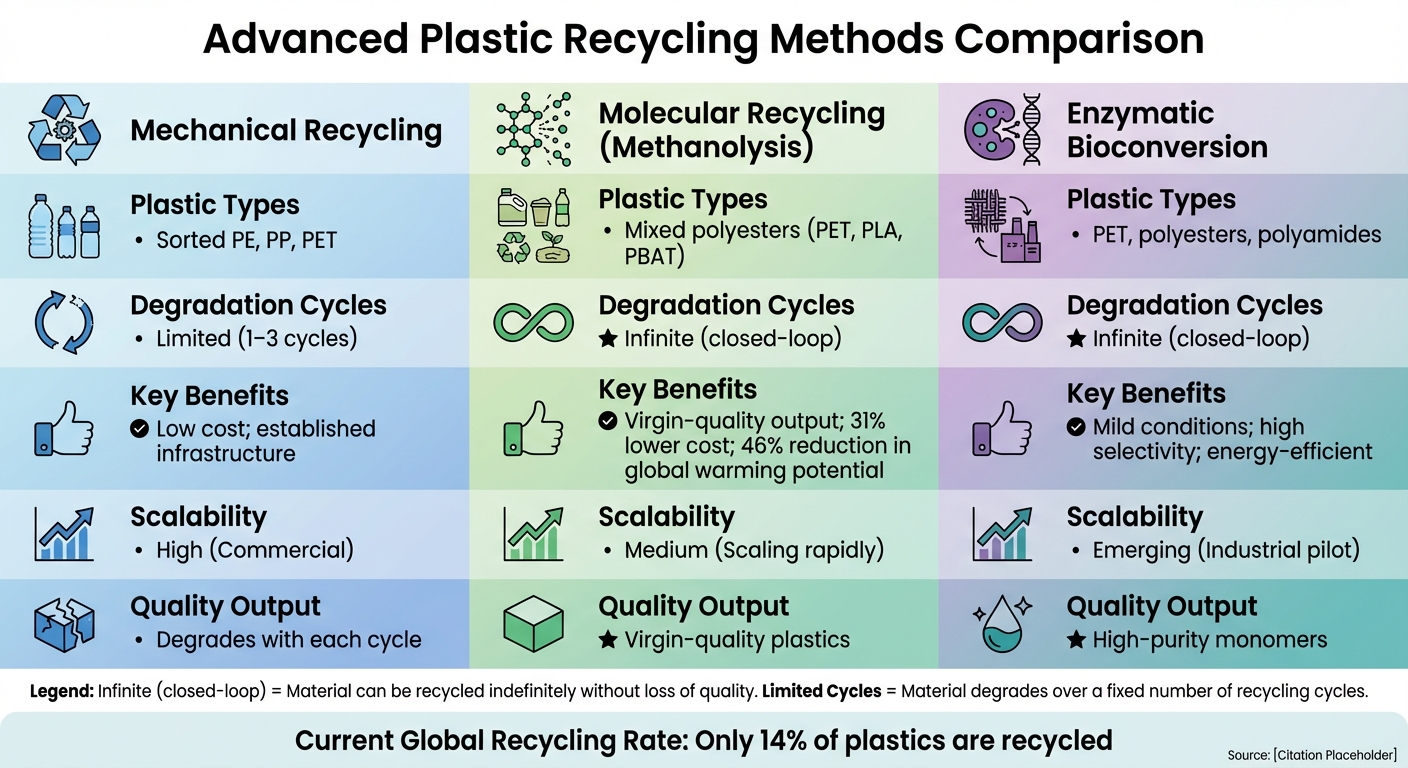
Comparison of Advanced Plastic Recycling Methods: Mechanical vs Molecular vs Enzymatic
Modern molecular techniques are taking plastic recycling to the next level, restoring materials to their original monomer state and allowing for endless reuse. Unlike traditional methods, these advanced approaches ensure the production of virgin-quality plastics, perfectly aligning with the goals of Circular Economy 2.0 to create a sustainable and efficient system.
One of the standout methods is catalytic methanolysis, which uses methanol and catalysts like amines to break down mixed polyesters such as PET, PLA, and PBAT into their base components. This process eliminates the need for complex sorting, handling mixed waste in a single reactor. The benefits are clear: methanolysis can reduce the cost of recycled plastics by 31% compared to traditional manufacturing, while also cutting global warming potential by up to 46%.
"Methanolysis outperforms glycolysis and hydrolysis economically and environmentally due to more efficient downstream separations, generating products with a 31% decrease in selling price."
– Jason S. DesVeaux, Researcher, National Renewable Energy Laboratory
Another promising approach is enzymatic depolymerization, which uses specially engineered enzymes to break down plastics under mild conditions. A notable success story comes from the French company Carbios, which has scaled this technology to industrial levels. By 2024, they had successfully converted PET bottles back into their monomers - terephthalic acid (TPA) and ethylene glycol (EG) - ready for repolymerization. This method’s mild operating conditions make it a more energy-efficient alternative to traditional thermal processes like pyrolysis.
Solvolysis of polyethylene-like materials is another cutting-edge technique. By designing polymers with built-in "break points", solvents like methanol or ethanol can recover over 96% of monomers while preserving the durability of high-density polyethylene (HDPE). Sumitomo Chemical has taken steps to commercialize pyrolysis-based recycling for acrylic resin (PMMA), building a pilot facility in Japan to decompose waste into methyl methacrylate (MMA) monomers as of August 2021.
Finally, there’s biological funneling, a hybrid method combining chemical oxidation with microbial processing. This approach breaks down mixed waste into intermediate products, which microbes then convert into high-value chemical building blocks. Acting as a "biorefinery", this method avoids producing homogenized oils, a common byproduct of conventional pyrolysis.
Each of these methods brings distinct advantages, making them suitable for different recycling challenges.
The choice of recycling method depends on factors like the type of plastic, the complexity of the waste stream, and the desired output quality. Here's a breakdown of how these technologies compare:
| Recycling Method | Plastic Types Processed | Degradation Cycles | Key Benefits | Scalability |
|---|---|---|---|---|
| Mechanical | Sorted PE, PP, PET | Limited (1–3 cycles) | Low cost; established infrastructure | High (Commercial) |
| Molecular (Methanolysis) | Mixed polyesters (PET, PLA, PBAT) | Infinite (closed-loop) | Virgin-quality output; lower cost | Medium (Scaling rapidly) |
| Bioconversion (Enzymatic) | PET, polyesters, polyamides | Infinite (closed-loop) | Mild conditions; high selectivity | Emerging (Industrial pilot) |
Mechanical recycling remains the go-to option for clean, sorted plastic waste. It’s cost-effective and supported by well-established infrastructure. However, its major drawback is that plastic quality degrades with each cycle, limiting its reuse to just 1–3 cycles.
For contaminated or mixed waste streams, molecular recycling methods like methanolysis shine. They recover monomers that can be repolymerized into virgin-quality plastics, making them ideal for applications where additives, inks, or food residues are present.
Enzymatic bioconversion, while still in its early stages, offers significant energy savings due to its mild operating conditions. Despite its potential, only about 14% of global plastic production is currently recycled by any method, highlighting the scale of the challenge.
"Chemical recycling via depolymerization to monomer offers an alternative that retains high-performance properties."
– Stefan Mecking, Professor of Chemical Materials Science, University of Konstanz
Ultimately, the best recycling method depends on the quality of the feedstock and economic considerations. Clean, sorted plastics are best suited for mechanical recycling, while molecular and enzymatic methods provide better results for mixed or contaminated waste. As these advanced technologies continue to scale, their costs are expected to become more competitive.
The practical use of advanced recycling methods is showing how Circular Economy 2.0 is making a real difference across various industries.
The packaging industry is leading the way in cutting costs and emissions with cutting-edge recycling technologies. For example, in September 2025, the BOTTLE Consortium successfully processed 1 kg of mixed polyester packaging waste using catalytic methanolysis. This process recovered high-purity monomers, which were then repolymerized into PET of virgin-like quality. The results? A 31% cost reduction and a decrease in global warming potential by up to 46%.
In another breakthrough, January 2025 saw a hybrid chemical-biological process convert post-consumer polystyrene into adipic acid. This method achieved an impressive 94% yield while slashing greenhouse gas emissions by 61%. Even better, it kept costs competitive at $3.18 per kilogram.
These advancements in packaging recycling are setting the stage for tackling more complex products with similar approaches.
Advanced recycling isn't just transforming packaging - it’s also making waves in the automotive and textile sectors. A study published in Science Advances highlighted the use of PDK resins for chemospecific recycling of bonded assemblies. These assemblies, made from stainless steel, glass, and PDK resins, were broken down using sequential mild acidic treatments. The process successfully recovered monomers and separated metals and glass, with iron contamination in monomers as low as 2.79 ppm.
"Chemical circularity in mixed-polymer recycling becomes possible by controlling the rates of depolymerization of polydiketoenamines (PDK) over several orders of magnitude through molecular engineering."
– Science Advances
In textiles, recycling efforts have achieved notable success as well. Processes targeting waste like carpets and mixed-fiber fabrics delivered monomer yields of 86–93%, producing materials comparable to those made from virgin feedstocks.
The concept of Circular Economy 2.0 is reshaping how we design, use, and recycle plastics. Right now, only 14% of plastic is recycled, and bioplastics make up a mere 0.5% of total production. However, by 2028, bioplastic production is expected to triple, with the U.S. aiming to replace 90% of traditional materials with biomaterials within the next two decades. These numbers highlight the pressing need for innovation in how we manage plastics.
One promising solution is the use of biodegradable additives, which allow manufacturers to add biodegradability to their existing production lines without requiring significant investment. Buff López of Cleantech Group explains:
"Plastic producers can easily add biodegradability to existing processes." – Buff López, Cleantech Group
This approach can cut the carbon footprint of products by nearly half while maintaining their strength and recyclability.
On the economic side, the outlook is also encouraging. By combining advanced recycling technologies with traditional mechanical recycling, it’s possible to meet over 30% of global polymer demand by 2040. This could result in cost savings of $150–$300 per ton while significantly reducing global warming potential.
However, tackling the plastic waste crisis requires more than just new technology. A systems-level overhaul is essential. This includes designing products with recovery in mind, improving collection and pretreatment infrastructure, and shifting from fossil-based plastics to biogenic alternatives. For instance, the European Union is working toward doubling its circularity rate to 24% by 2030.
The path forward involves a combination of strategies. Biodegradable additives, chemical and mechanical recycling, and advanced biological methods all play a role in creating a circular system. By adopting these technologies now, industries can prepare for stricter regulations while unlocking economic and environmental benefits.
Catalytic methanolysis leverages a methanol-based catalyst to chemically decompose mixed polyester waste back into its original monomers. These monomers can then be reprocessed into high-quality plastics, supporting a closed-loop recycling system that reduces waste and preserves the integrity of the materials.
On the other hand, traditional recycling methods often depend on mechanical processes, such as melting, or less refined chemical techniques. These methods usually result in lower-grade materials, which are downcycled into products of lesser value rather than being fully restored for use in demanding applications.
Biodegradable additives are crafted to help plastics break down more efficiently when they reach the end of their useful life. These additives work by introducing compounds that speed up the breakdown of polymer chains under specific conditions, such as composting, soil, or marine environments. The process reduces plastics into smaller fragments that microbes can naturally process into carbon dioxide, water, and biomass, significantly cutting down the time plastics linger in the environment.
In the framework of Circular Economy 2.0, these additives also play a role in advanced recycling techniques. By pre-conditioning plastics for enzymatic recycling, they simplify the breakdown of polymers, making it possible to convert them into valuable materials like new bioplastics or high-quality chemicals. To ensure their success, it’s crucial to align the additive chemistry with the intended disposal method and assess their environmental impact. This ensures that plastics maintain their performance during use while contributing to broader sustainability efforts.
Using renewable energy sources like solar and wind power in plastic recycling can drastically cut down the dependence on fossil fuels. This shift not only reduces carbon emissions but also makes the entire recycling process cleaner. Whether it’s mechanical shredding, extrusion, or advanced bioconversion techniques, powering these operations with renewable energy helps lower the greenhouse gas footprint of recycled plastics. This approach aligns with the goals of creating a more sustainable and efficient circular economy.
Clean energy also opens the door for scaling up energy-intensive methods like chemical depolymerization or enzymatic recycling without adding to environmental harm. On top of that, recycling facilities can capture byproducts like residual heat or biogas during operations and repurpose them to boost energy efficiency. This not only minimizes waste but also further reduces emissions, making the process even more eco-friendly.