


December 13, 2025
Regenerative plastics are reshaping how we think about plastic production and waste. These materials, derived from renewable resources like corn starch and algae, are designed to be biodegradable or recyclable, offering a way to tackle the growing global plastic crisis. Here's why this matters:
Regenerative plastics not only address plastic waste but also create new opportunities for businesses to innovate while staying ahead of regulatory and market trends.
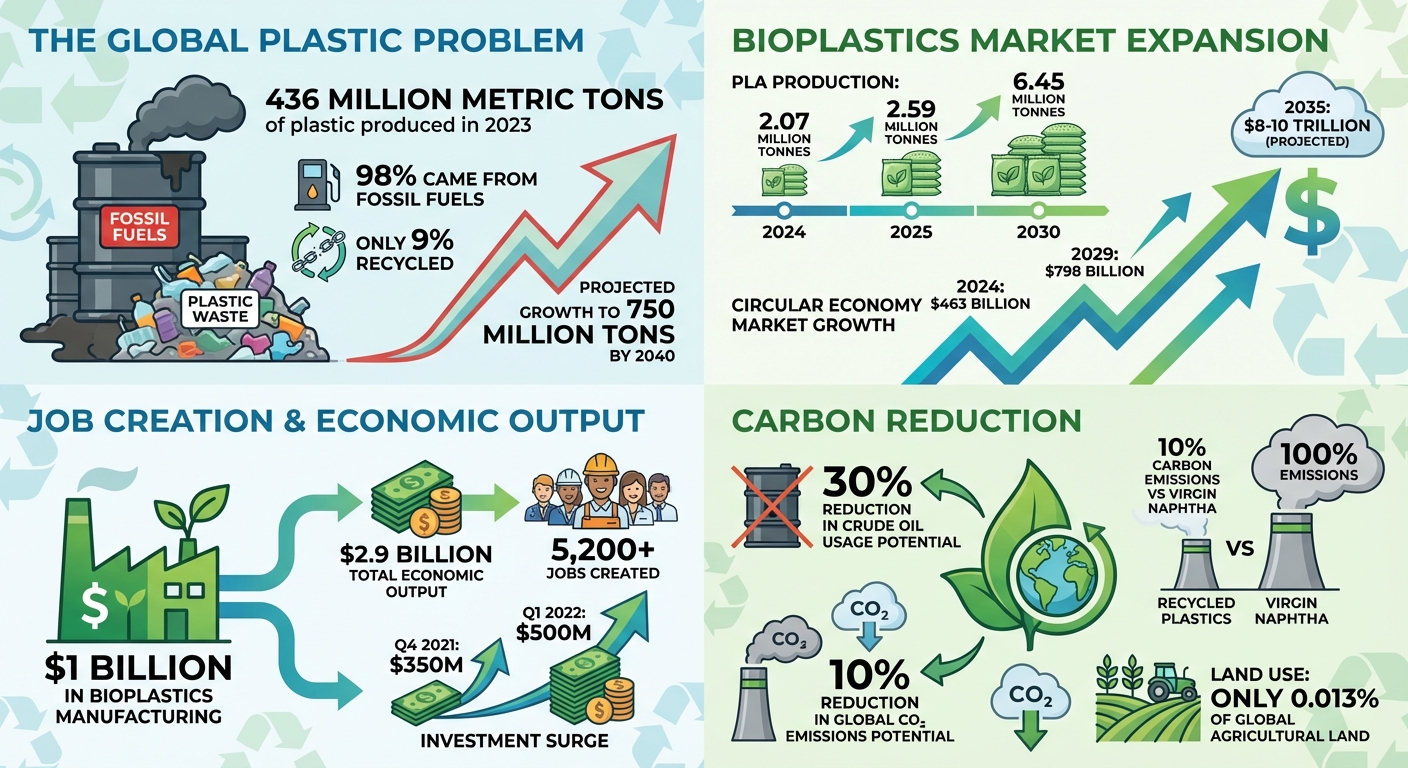
Global Plastic Production and Regenerative Plastics Market Growth Statistics 2023-2040
The global bioplastics market is growing at a fast pace, fueled by stricter regulations on plastics, a rising demand for eco-friendly packaging, and growing concerns about the impact of petrochemicals. Many companies are also stepping up, setting ambitious sustainability goals to minimize their environmental impact. At the same time, advancements in biodegradable additive technologies are improving the performance of regenerative plastics, making them a strong competitor to traditional materials and expanding their potential uses.
This shift isn't just good for the planet - it makes economic sense too. With crude oil supplies becoming less predictable and more expensive, regenerative plastics offer a stable, forward-looking alternative to petroleum-based products.
These global dynamics are shaping key trends and opportunities, especially in the U.S. market.
In the U.S., the bioplastics market is seeing considerable growth, building on global momentum. Consumer demand for sustainable products is on the rise, and state-level policies are encouraging the adoption of bioplastics. Industries across the country are increasingly turning to circular polymers and recycled content, spurred by corporate commitments to sustainability and evolving regulatory landscapes. Since 2018, billions of dollars have been invested in advanced recycling technologies in the U.S., further supporting this transition. Policies like Extended Producer Responsibility (EPR) laws and federal programs such as the USDA BioPreferred Program are giving businesses additional incentives to embrace regenerative plastics.
For manufacturers, this creates a wealth of opportunities. By incorporating biodegradable additives into their production processes, they can tap into expanding markets, meet regulatory demands, and align with consumer expectations for greener products.
Additives that improve both functionality and environmental compatibility are a key component of regenerative plastics. By replacing synthetic options with bio-based functional additives, manufacturers can produce materials that are both efficient and eco-friendly. This shift addresses a major issue: many bioplastics struggle with weak physical and mechanical properties, limiting their commercial use. To tackle this, researchers and industry leaders are working to create better, fully bio-based formulations.
The financial sector has taken notice of this progress. Investments in bioplastics hit $500 million in the first quarter of 2022, surpassing the previous record of $350 million in the last quarter of 2021. This surge highlights growing confidence in additive technologies that make regenerative plastics more competitive with traditional materials.
Here are some of the key additive technologies driving this transformation.
Plasticizers play a crucial role in making flexible packaging and films that are durable yet compostable. In the production of thermoplastic starch (TPS), plasticizers like glycerol, polyols, sugars, and citric acid are used to enhance processability. These additives enable starch-based plastics to meet the demands of industries such as packaging, food service, textiles, and pharmaceuticals, all while maintaining compostability.
The economic ripple effect is significant. For instance, an additional $1 billion in bioplastics manufacturing could generate $2.9 billion in total economic output and create over 5,200 jobs across the U.S.. Plasticizers are a key factor in this growth, allowing regenerative plastics to rival the flexibility and performance of traditional petroleum-based films without sacrificing environmental benefits. Similarly, pro-degradants tackle waste management challenges by speeding up the breakdown of plastics.
Pro-degradants are additives designed to accelerate the decomposition of plastics in environments like landfills and oceans. These additives address one of the most pressing issues with plastic waste: its long-lasting presence in the environment. By speeding up degradation, pro-degradants reduce the long-term environmental impact and meet growing consumer and regulatory demands for better disposal solutions.
When incorporated into plastics, these biodegradable additives help materials break down into non-toxic biomass in microbe-rich environments, all while remaining compatible with standard manufacturing processes. Beyond aiding decomposition, these technologies also support applications where safety is paramount.
Antimicrobial additives are particularly valuable in food packaging, where they extend shelf life and improve safety by preventing microbial growth. This not only addresses health concerns but also helps reduce food waste. Flame retardant additives, on the other hand, ensure that regenerative plastics meet fire safety standards in industries like electronics, construction, and transportation.
"The dwindling of fossil resources provides a strong drive to the development of bio-based products, while the possibility to mitigate environmental pollution or simplify organic waste collection are big motivations behind the development of biodegradable and compostable plastic products."
- Alberto Di Bartolo, Giulia Infurna, Nadka Tzankova Dintcheva, Dipartimento di Ingegneria, Università degli Studi di Palermo
With the global bioplastics market expected to grow by about 40% in volume over the next five years, these additives are not only enhancing material performance but also opening doors to new applications. By improving functionality and expanding market opportunities, these technologies make a compelling case for the shift to regenerative plastics.
These advancements pave the way for further discussions on the economic and scalability strategies for regenerative plastics.
Making the shift to regenerative plastics requires a clear understanding of their costs and how they fit into current manufacturing systems. While bioplastics often come with higher production costs today, scaling up production is helping close this gap. This economic evolution supports the broader move toward circular and sustainable practices. To make these materials economically viable, it's crucial to break down cost drivers and identify strategies for profitability.
The main cost factors for regenerative plastics like polyethylene furanoate (PEF) and polytrimethylene terephthalate (PTT) are utilities and the raw materials needed to produce intermediate chemicals, such as 2,5-furandicarboxylic acid (FDCA). For example, second-generation feedstocks like lignocellulosic material, derived from cellulose, add complexity to the process. Even though these feedstocks often come from waste, the additional processing requirements increase raw material costs.
That said, scaling up production significantly lowers per-unit costs. For instance, global production of Polylactic Acid (PLA) is expected to grow from 2.07 million tonnes in 2024 to 2.59 million tonnes in 2025, eventually reaching 6.45 million tonnes by 2030. This kind of growth helps drive down costs while maintaining minimal impact on resources - bioplastics currently use only 0.013% of global agricultural land, ensuring food security remains unaffected.
Beyond production costs, there are long-term financial advantages. Companies adopting regenerative plastics can avoid rising social and environmental liabilities. Incentives like Extended Producer Responsibility (EPR) programs and government subsidies further ease the financial burden. While upfront expenses remain higher for now, businesses benefit from reduced compliance risks, stronger market positioning, and protection against future regulations targeting traditional plastics. These factors make regenerative plastics an increasingly practical choice for integration into existing systems.
Regenerative plastics are designed to work within current manufacturing and recycling frameworks. For instance, PLA offers multiple end-of-life options, including mechanical and chemical recycling, as well as industrial composting, allowing for easy adoption without requiring costly system overhauls. Similarly, bio-based plastics like bio-polyethylene are compatible with conventional recycling methods, whether mechanical or chemical.
Chemical recycling is particularly effective in managing complex waste streams, eliminating the need for significant operational changes. This compatibility reduces capital expenses and shortens adoption timelines, making regenerative plastics a practical and economically viable solution. As production volumes grow, the case for these materials becomes even stronger, offering a sustainable pathway for industries to innovate without disrupting their existing systems.
Examples from various industries show how regenerative plastics are moving from an idea to a practical solution. Companies in packaging, textiles, and consumer goods are adopting these materials to balance sustainability with performance and profitability.
LanzaTech has made strides in carbon-capture–based packaging by teaming up with brands like Unilever, L'Oréal, Danone, and Zara. Their process converts captured CO₂ into polymer precursors such as ethanol and MEG, which can replace petroleum-based materials in packaging. This approach has the potential to cut crude oil usage by 30% and reduce global CO₂ emissions by 10%.
The industry is also experimenting with seaweed-based materials, which grow quickly, require minimal resources, and positively impact marine ecosystems. These materials naturally break down at the end of their lifecycle. Certifications, like those from the Biodegradable Products Institute (BPI), help confirm their compostability. These advancements set an example for other industries looking to incorporate sustainable materials.
Ecovative has developed mycelium-based materials that mimic leather and high-performance foams for use in apparel and beauty products. By growing mycelium - the root structure of fungi - on agricultural byproducts, they create materials that are durable, lightweight, and biodegradable. Additionally, fashion brands like Lululemon and On are collaborating with LanzaTech to incorporate carbon-capture–based polymer precursors into items like shoes and athletic wear.
These examples highlight how regenerative plastics can offer both environmental and economic advantages when paired with the right technologies. The challenge lies not in the effectiveness of these materials but in choosing the right solutions and ensuring they integrate smoothly into existing production processes. These efforts demonstrate the scalability and financial practicality of regenerative plastics, reinforcing their potential for widespread adoption.
Regenerative plastics play a key role in advancing a circular economy by transforming waste into valuable resources, significantly reducing the need for virgin raw materials [23–27]. This shift not only helps address landfill overflow but also creates opportunities for financial gains while tackling environmental concerns.
Using regenerative plastics can lower operational expenses by optimizing resource use while opening up new revenue streams through repurposed products and innovative services [29,31]. Financial incentives such as government grants, tax credits, extended producer responsibility (EPR) programs, and carbon pricing further strengthen the case for adopting circular models [29,32,35].
These cost savings align with earlier findings that highlight reduced per-unit costs as production scales up, enhancing the economic stability of regenerative plastics. Under EPR programs, the burden of managing end-of-life materials shifts from taxpayers to producers, encouraging eco-friendly design and efficient recycling [32,35]. Additionally, recycling plastic waste to create new products results in only 10% of the carbon emissions compared to using virgin naphtha. This not only cuts emissions but also opens the door to earning carbon credits.
While the immediate financial benefits are compelling, long-term strategies suggest even greater potential. By 2030, regenerative plastics are expected to achieve cost parity with virgin plastics. The circular economy market is projected to nearly double, growing from $463 billion in 2024 to $798 billion by 2029, with annual growth rates exceeding 15%. Rising production volumes and increasing demand for recycled materials, driven by stricter packaging regulations, are expected to further drive down costs [33,35].
"The circular-economy market is not a slow-burn niche; it is riding the same mutually reinforcing disruption waves that are dismantling the 20th-century industrial system", says Nafeez M Ahmed, Creator of the Age of Transformation and Director at Unitas Futures Lab.
Technological advancements and the declining costs of renewable energy are accelerating this transition. Over the past decade, solar photovoltaic costs have dropped by 90%, onshore wind by 70%, and battery storage by over 90%. These reductions make energy-intensive circular processes more economically feasible at scale. Meanwhile, innovations like blockchain and artificial intelligence are improving supply chain efficiency and reducing costs tied to design and remanufacturing. Between 2028 and 2035, policy and financial initiatives are expected to drive adoption further, with growth rates of 30–35% annually, potentially pushing the market's value to $8–10 trillion by 2035. Companies investing now in advanced recycling technologies and resource-efficient solutions are well-positioned to capitalize on the economies of scale as circular practices become mainstream.
The financial advantages of regenerative plastics are hard to ignore, as highlighted by the analysis and examples above.
By using regenerative plastics, companies can cut costs, open up new revenue opportunities, and enhance their competitive edge - all while tackling environmental issues. Streamlining resource use leads to lower expenses for raw materials, waste management, and energy. Many businesses even see a return on their investment relatively quickly. Additionally, regenerative plastics create value by turning waste into usable resources. For instance, biodegradable additives maintain product performance and recyclability without requiring changes to existing manufacturing processes.
Although production costs are currently higher, advancements in scaling and supportive policies are helping to make these materials more feasible. For businesses focused on sustainability, solutions like BioFuture Additives offer a practical way forward. Their biodegradable additives work seamlessly with current systems, ensuring products remain functional and recyclable.
Investing in regenerative plastics also positions companies to meet the rising consumer demand for environmentally friendly products. Beyond addressing immediate financial and regulatory needs, this shift sets the stage for a stronger, more circular economy in the future.
Regenerative plastics represent a step forward in addressing the challenges of plastic waste. Unlike conventional plastics derived from fossil fuels - which can linger in the environment for hundreds of years - these materials are designed to be bio-based, biodegradable, or recyclable, offering a more environmentally friendly alternative.
What sets regenerative plastics apart is their ability to integrate biodegradable additives or advanced formulations that align with the principles of a circular economy. This means they can be reused, recycled, or naturally break down over time. On the other hand, traditional plastics rely heavily on petrochemicals and are typically non-biodegradable, making them a significant contributor to long-term pollution.
Biodegradable additives are essential in making regenerative plastics more environmentally friendly. These additives speed up the breakdown process in natural settings, reducing the lasting impact on the planet and contributing to a circular economy.
Beyond aiding decomposition, these additives can also boost the performance of regenerative plastics. They can improve features like flexibility or gas barrier properties, making the materials more adaptable for various uses. This means businesses can embrace sustainable practices while still achieving the functionality and efficiency they need.
Switching to regenerative plastics isn't just good for the planet - it can also be a smart financial move for businesses. By cutting down on the use of traditional raw materials and energy-intensive production methods, companies can significantly trim their costs. Plus, with the rising demand for environmentally friendly products, businesses have a chance to tap into thriving green markets and unlock new revenue streams.
On top of that, regenerative plastics can act as a buffer against unpredictable raw material prices, providing greater financial stability. They also help boost a company’s image by aligning with the growing consumer demand for sustainable practices, which can translate into stronger customer loyalty. And let’s not forget, adopting eco-conscious methods can open doors to sustainable investment funds and incentives, giving businesses an extra edge in ensuring long-term profitability.