

February 5, 2026
The ASTM D5526 test evaluates how plastics break down in anaerobic landfill conditions, converting carbon into methane and carbon dioxide. It uses controlled, high-solid, oxygen-free environments to simulate landfill behavior. While it provides insights into biodegradation rates and gas production, the method was withdrawn in July 2025 but remains a reference for analyzing plastic decomposition under landfill conditions. Key points:
The method helps manufacturers understand how materials behave in landfills, aiding in the development of plastics designed to break down more efficiently and safely.
This section breaks down how the D5526 method operates, connecting the lab procedures directly to landfill behavior. It covers the test setup, environmental conditions, and how biodegradation is measured.
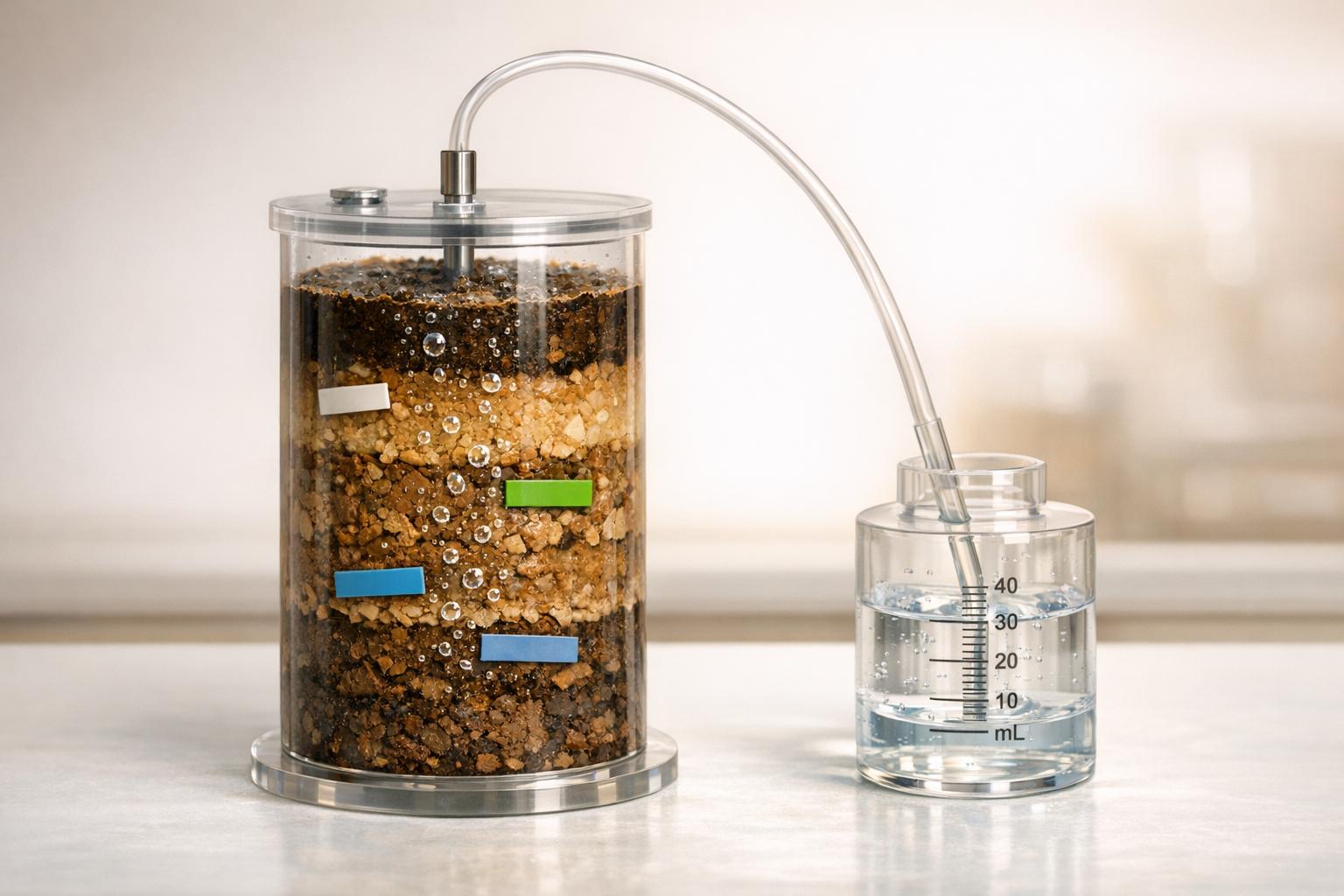
The process starts by preparing a methanogenic inoculum, which comes from anaerobic digesters that treat preprocessed household waste. This inoculum supplies the microorganisms necessary to break down organic materials without oxygen. Plastic samples are mixed with this inoculum and pretreated waste. The mixture is then sealed in airtight containers to ensure anaerobic conditions are maintained. As ASTM International puts it:
This procedure creates a standard laboratory environment for determining anaerobic biodegradability under accelerated landfill conditions.
Once the mixture is prepared and sealed, the test conditions are carefully controlled to replicate landfill environments.
The containers are incubated at specific temperatures designed to simulate accelerated landfill conditions. The test is conducted in "dry" conditions, which means the total solids content exceeds 30%. Additionally, the setup uses static, non-mixed conditions to mimic the physical state of a landfill. Airtight seals are crucial - any oxygen leakage would disrupt the anaerobic environment. Since methane is produced during the process, strict ventilation and gas monitoring protocols are followed.
These controlled conditions allow researchers to monitor the breakdown of the plastic over time.
The progress of biodegradation is assessed by measuring the conversion of the plastic's carbon into methane (CH₄) and carbon dioxide (CO₂). Researchers track total gas production, the rate of methane generation, and the weight loss of the material. The results are reported as the percentage of carbon from the plastic that has been turned into biogas during the test period. This provides a snapshot of the material's breakdown within the test's timeframe.
D5526 plays a key role in helping industries determine whether plastics break down safely under landfill conditions. The test delivers critical insights for designing products with reduced environmental impact. It also lays the groundwork for incorporating additives that promote biodegradation.
Biodegradable additives are designed to improve how plastics break down into biomass and biogas - specifically methane and carbon dioxide - by attracting microbes. Companies like BioFuture Additives rely on standardized tests to confirm that their additives effectively boost the decomposition of conventional polymers in landfill settings. These additives activate only in environments rich in microbes, such as those with high solids content (over 30%) and static, non-mixed conditions, which align with D5526’s aim to replicate landfill conditions. Notably, these additives maintain the material's physical integrity, shelf life, and functionality during its intended use. By increasing the rate of carbon conversion to gas, they also improve the economic viability of landfill gas recovery systems.
In addition to speeding up biodegradation, the test ensures the environmental safety of the resulting degraded plastics. D5526 evaluates whether plastics decompose properly under the typical conditions found in biologically active landfills. Beyond measuring gas emissions, it includes ecotoxicity checks to ensure no harmful byproducts are produced. As ASTM International highlights:
It is of immediate concern that the plastic materials do not produce toxic metabolites or end products under the various conditions that have the potential to occur in a landfill.
This comprehensive approach - assessing both degradation rates and environmental safety - makes D5526 indispensable for manufacturers working on bioplastics such as PLA and PHA, as well as traditional plastics enhanced with biodegradable additives. Ensuring both aspects aligns with the broader goal of a sustainable circular economy. Commercial testing fees for D5526 typically start at around $100, though the cost depends on factors like sample quantity and material type.
After setting up the D5526 test, interpreting the results becomes essential for assessing biodegradation. The main focus here is the percentage of plastic carbon that converts into gas. This test measures how much carbon from the sample transforms into methane (CH₄) and carbon dioxide (CO₂) during the incubation period. Labs determine this by comparing the initial carbon content in the plastic to the carbon released as gas over the test's duration, which often lasts for four months or more.
The results are presented as the percentage of net gaseous carbon generation, alongside other indicators like weight loss and methane production rate, which provide additional insights into the process. However, ASTM International enforces strict guidelines on how these results can be interpreted:
Claims of performance shall be limited to the numerical result obtained in the test and not be used for unqualified 'biodegradable' claims.
This limitation exists because the test reflects performance under controlled lab conditions, which may not fully replicate how materials behave in actual landfill environments. Furthermore, states such as California and Maryland have laws that prohibit labeling plastic products as "biodegradable" or "degradable", regardless of test results.
These metrics not only validate biodegradation but also highlight the potential economic and environmental advantages within a circular economy framework.
Strong D5526 results can reveal a material's ability to support renewable energy recovery in landfills. When plastics decompose quickly into methane, they improve the economic feasibility of landfill gas recovery systems, which transform waste into energy. This faster breakdown also reduces the physical space waste occupies and shortens the time required for landfill aftercare.
For manufacturers, favorable test outcomes demonstrate that their biodegradable additives align with goals for carbon neutrality and waste reduction. The test also includes an ecotoxicity evaluation, checking degraded materials for harmful byproducts. This ensures that products contribute positively to a circular economy without introducing environmental risks. By combining data on decomposition rates and safety, D5526 results become a vital tool for companies dedicated to developing sustainable products.

ASTM D5526 vs D5511 vs D6400 Biodegradation Testing Standards Comparison
When examining the D5526 test, it’s important to understand its constraints. This test operates under accelerated conditions that don't fully replicate what happens in actual landfills. For instance, while real-world landfills typically maintain a moisture content of about 35%, the D5526 method uses higher levels - generally between 45% and 48% - to speed up biodegradation in the lab. This makes it hard to directly apply the results to real landfill environments.
Additionally, the test is conducted in small bioreactors (ranging from 0.1 to 2.0 liters), which don’t capture the complexity of full-scale landfill operations. The static, non-mixed conditions used in the method fail to reflect the dynamic processes of large-scale landfills. As noted in the Journal of Environmental Chemical Engineering:
"The static conditions set by the standard methods are not representative of the dynamic processes that occur in natural or industrial environments."
These limitations underscore the difficulty of translating lab findings into practical landfill management strategies. It's also worth noting that ASTM D5526-18 was officially withdrawn in July 2025.
Given its limitations, comparing D5526 to other biodegradation standards can provide valuable context. The table below outlines some of the key differences:
| Feature | ASTM D5526 | ASTM D5511 | ASTM D6400 |
|---|---|---|---|
| Environment | Anaerobic (Accelerated Landfill) | Anaerobic (High-Solids Digestion) | Aerobic (Industrial Composting) |
| Primary Application | All active landfill environments | Bioreactor landfills/Digesters | Municipal/Industrial Composters |
| Typical Duration | 3–6 months or longer | Approximately 45 days | 180 days |
| Temperature | Typically 95°F or 131°F (35°C or 55°C) | 126°F–131°F (52°C–55°C) | Approximately 140°F (60°C) |
| Realism | High (simulates landfill stress) | Low (idealized lab conditions) | Specific to industrial composting |
| Current Status | Previously active (withdrawn July 2025) | Active | Active |
One of the most striking differences lies in the test duration. For example, a material that fully degrades in 250 days under ASTM D5511 might take as long as five years under ASTM D5526 conditions. This illustrates that ASTM D5526 imposes stricter conditions, better reflecting the slower and more variable processes in landfills compared to the controlled environments of digestion systems.
The D5526 test method provides a structured way to assess how plastics break down in landfill conditions. By tracking the conversion of carbon into methane and carbon dioxide, it offers manufacturers essential insights into how materials perform in oxygen-free environments. This data helps evaluate whether certain plastics can reduce overall waste volume and contribute to the economic viability of landfill-gas recovery while potentially shortening after-care periods. However, results from this test should focus on specific numerical data rather than broad claims like "biodegradable", in compliance with regulations in states such as California and Maryland. These findings play a crucial role in driving material development and waste management strategies.
The principles behind D5526 remain relevant for advancing sustainable plastics. This method has been instrumental in testing bioplastics like PLA and PHA, which are increasingly used in industries such as packaging, agriculture, and consumer goods.
Manufacturers adopting biodegradable additives - such as those developed by BioFuture Additives, which enable plastics to transform into non-toxic biomass in microbe-rich environments - can use these principles to support carbon-neutral and circular economy goals. These testing methodologies also ensure that new materials retain their functionality and recyclability. As ASTM Committee D20 explores alternatives to replace D5526, manufacturers will need to stay updated on emerging standards.
The path toward sustainable plastics hinges on testing methods that balance environmental responsibility with practical usability. While D5526 may not perfectly simulate every real-world scenario, it has laid the groundwork for evaluating landfill-bound materials. This framework will continue to shape how biodegradable solutions are developed and assessed in the future.
The D5526 test method was discontinued in 2025 after being reviewed and withdrawn because it didn’t accurately represent how plastics biodegrade in real landfill conditions. The results often failed to provide a reliable picture of what actually happens in landfills, making the method less useful and precise for practical applications.
With growing emphasis on sustainability, there’s now a stronger focus on adopting methods that more effectively evaluate the environmental impact of materials like plastics.
The D5526 test stands out because it examines how plastics break down through anaerobic biodegradation in conditions that mimic a fast-tracked landfill environment. This test evaluates the conversion of plastics into gases like methane and carbon dioxide in oxygen-free settings.
In contrast, the D5511 test also measures anaerobic biodegradation but focuses on high-solids digestion systems, commonly used in waste treatment and composting processes. Meanwhile, the D6400 test assesses aerobic biodegradation to determine how plastics decompose in oxygen-rich environments, ensuring they meet compostability standards.
Each of these tests serves a specific purpose, with D5526 being particularly useful for gauging how plastics behave in landfill-like conditions.
The D5526 test method assesses how plastics might degrade in oxygen-free, microbe-rich environments, like those found in landfills. While it sheds light on their potential for anaerobic biodegradation, it doesn't confirm complete biodegradability across all conditions. Instead, it offers a way to understand how these materials could break down over time in such specific settings.