

February 18, 2026
Plastics and microplastics don't leave ecosystems.
They don't disappear.
Instead, they fragment, circulate through oceans and soils, enter food chains, and accumulate for centuries — without ever truly exiting the biosphere in any meaningful human timeframe.
That means the plastic produced today becomes part of the environment... essentially forever.
The U.S. National Oceanic and Atmospheric Administration (NOAA) confirms that microplastics persist in the environment and are extremely difficult to remove once dispersed:
https://oceanservice.noaa.gov/facts/microplastics.html
The United Nations Environment Programme (UNEP) calls plastic pollution one of the most pressing environmental challenges facing humanity:
https://www.unep.org/plastic-pollution
Microplastics are no longer only an ocean issue. They are now detected across ecosystems — and increasingly across biological systems.
Peer-reviewed research has confirmed microplastics in human blood (Environment International, 2022):
https://www.sciencedirect.com/science/article/pii/S0160412022001258
The World Health Organization (WHO) has highlighted growing concern around microplastics in drinking water and the need for deeper risk assessment:
https://www.who.int/publications/i/item/9789241516198
For global brands, this signals a shift:
It is about long-term biological presence.
Many materials marketed as "degradable" do not truly vanish — they fragment.
The European Commission has explicitly restricted oxo-degradable plastics because they contribute to microplastic pollution rather than full biodegradation:
EU Commission Statement:
https://environment.ec.europa.eu/topics/plastics/oxo-degradable-plastics_en
This distinction is critical for brand integrity:
Fragmentation creates smaller pollution.
BioConversion eliminates the polymer.
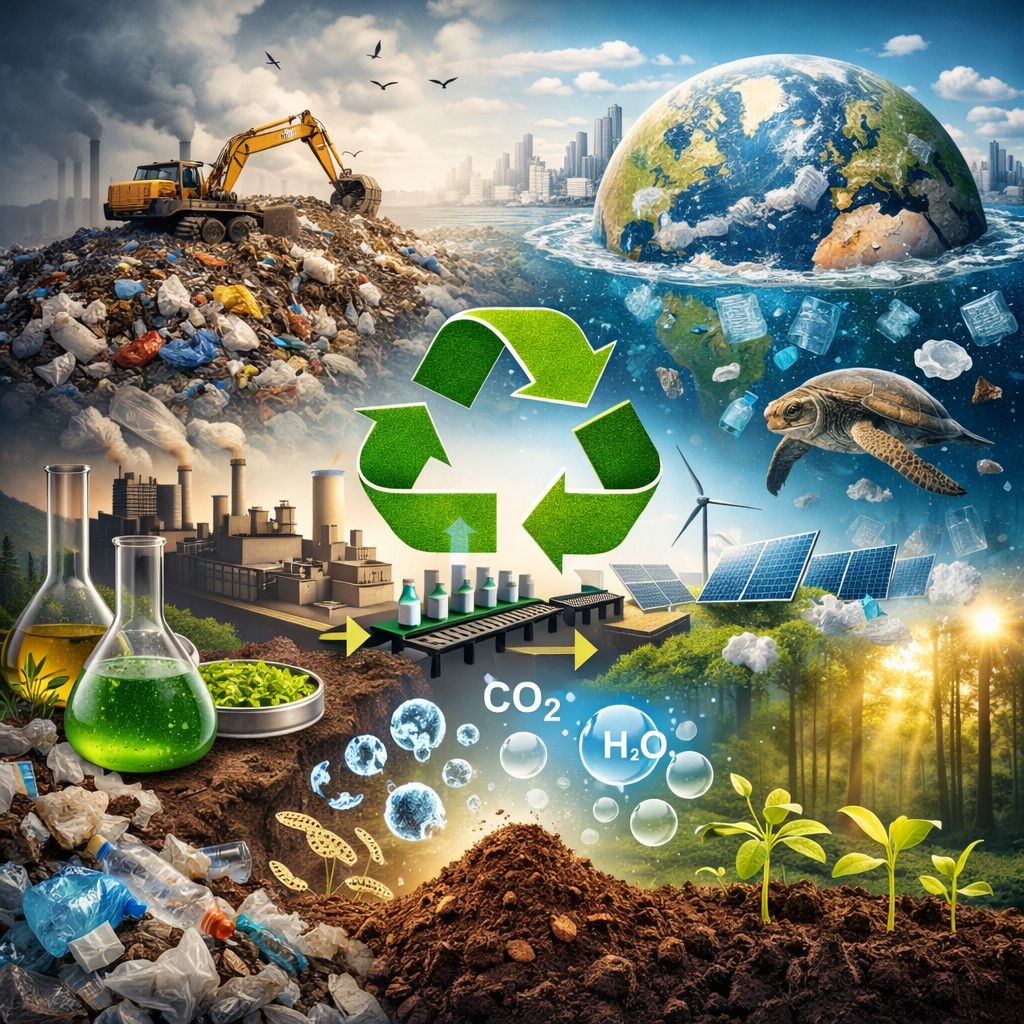
True environmental resolution requires microbial assimilation:
Polymer → Smaller Compounds → Microbial Metabolism → CO₂ + H₂O + Biomass
Scientific breakthroughs confirm this pathway is biologically possible.
A landmark Nature publication identified plastic-degrading enzymes (PETase), demonstrating that microbes can metabolize synthetic polymers under the right conditions:
Nature (2018):
https://www.nature.com/articles/s41586-018-0080-1
This is the foundation of next-generation sustainable materials:
Not plastics designed to persist...
but plastics designed to safely return to nature.
BioFuture Additives was built for the reality that plastics inevitably reach microbial end-of-life environments:
Our proprietary BioConversion™ additive technology enables conventional polymers to follow a new outcome:
✔ Maintain durability and performance in use
✔ Activate only in microbial-rich environments
✔ Undergo accelerated microbial colonization
✔ Bioconvert into fertile biomass within years
✔ Prevent long-term microplastic accumulation
This is how plastics can finally leave the ecosystem — safely, naturally, and compliantly.
Explore the science:
https://www.biofutureadditives.com/science
BioFuture Additives aligns with globally recognized biodegradation and safety frameworks:
ASTM International:
https://www.astm.org
We also comply with:
The World Economic Forum warns that without systemic change, plastic leakage into oceans could nearly triple by 2040:
WEF Insight:
https://www.weforum.org/agenda/2020/10/plastic-pollution-oceans/
The Ellen MacArthur Foundation — one of the world's most trusted circular economy authorities — states clearly:
"The plastics system is broken — and must be redesigned."
https://ellenmacarthurfoundation.org/topics/plastics/overview
And the UN Global Plastics Treaty negotiations are accelerating worldwide regulatory momentum:
UNEP Treaty Process:
https://www.unep.org/plastic-pollution
For brands, this is now about:
BioFuture Additives enables that leadership:
Not persistence. Not fragmentation.
Regeneration.
BioFuture Additives helps polymers and textiles transition from permanent pollution...
to biological regeneration.
✅ Request a Compliance & Testing Pack
✅ Explore Food-Contact Safe Applications
✅ Get Samples for Pilot Integration
Get Samples: https://www.biofutureadditives.com/contact
📧 dean@biofutureadditives.com
Dean@BioFutureAdditives.com
Plastics and microplastics don't leave ecosystems.
They don't disappear.
Instead, they fragment, circulate through oceans and soils, enter food chains, and accumulate for centuries — without ever truly exiting the biosphere in any meaningful human timeframe.
That means the plastic produced today becomes part of the environment... essentially forever.
The U.S. National Oceanic and Atmospheric Administration (NOAA) confirms that microplastics persist in the environment and are extremely difficult to remove once dispersed:
https://oceanservice.noaa.gov/facts/microplastics.html
The United Nations Environment Programme (UNEP) calls plastic pollution one of the most pressing environmental challenges facing humanity:
https://www.unep.org/plastic-pollution
Microplastics are no longer only an ocean issue. They are now detected across ecosystems — and increasingly across biological systems.
Peer-reviewed research has confirmed microplastics in human blood (Environment International, 2022):
https://www.sciencedirect.com/science/article/pii/S0160412022001258
The World Health Organization (WHO) has highlighted growing concern around microplastics in drinking water and the need for deeper risk assessment:
https://www.who.int/publications/i/item/9789241516198
For global brands, this signals a shift:
It is about long-term biological presence.
Many materials marketed as "degradable" do not truly vanish — they fragment.
The European Commission has explicitly restricted oxo-degradable plastics because they contribute to microplastic pollution rather than full biodegradation:
EU Commission Statement:
https://environment.ec.europa.eu/topics/plastics/oxo-degradable-plastics_en
This distinction is critical for brand integrity:
Fragmentation creates smaller pollution.
BioConversion eliminates the polymer.
True environmental resolution requires microbial assimilation:
Polymer → Smaller Compounds → Microbial Metabolism → CO₂ + H₂O + Biomass
Scientific breakthroughs confirm this pathway is biologically possible.
A landmark Nature publication identified plastic-degrading enzymes (PETase), demonstrating that microbes can metabolize synthetic polymers under the right conditions:
Nature (2018):
https://www.nature.com/articles/s41586-018-0080-1
This is the foundation of next-generation sustainable materials:
Not plastics designed to persist...
but plastics designed to safely return to nature.
BioFuture Additives was built for the reality that plastics inevitably reach microbial end-of-life environments:
Our proprietary BioConversion™ additive technology enables conventional polymers to follow a new outcome:
✔ Maintain durability and performance in use
✔ Activate only in microbial-rich environments
✔ Undergo accelerated microbial colonization
✔ Bioconvert into fertile biomass within years
✔ Prevent long-term microplastic accumulation
This is how plastics can finally leave the ecosystem — safely, naturally, and compliantly.
Explore the science:
https://www.biofutureadditives.com/science
BioFuture Additives aligns with globally recognized biodegradation and safety frameworks:
ASTM International:
https://www.astm.org
We also comply with:
The World Economic Forum warns that without systemic change, plastic leakage into oceans could nearly triple by 2040:
WEF Insight:
https://www.weforum.org/agenda/2020/10/plastic-pollution-oceans/
The Ellen MacArthur Foundation — one of the world's most trusted circular economy authorities — states clearly:
"The plastics system is broken — and must be redesigned."
https://ellenmacarthurfoundation.org/topics/plastics/overview
And the UN Global Plastics Treaty negotiations are accelerating worldwide regulatory momentum:
UNEP Treaty Process:
https://www.unep.org/plastic-pollution
For brands, this is now about:
BioFuture Additives enables that leadership:
Not persistence. Not fragmentation.
Regeneration.
BioFuture Additives helps polymers and textiles transition from permanent pollution...
to biological regeneration.
✅ Request a Compliance & Testing Pack
✅ Explore Food-Contact Safe Applications
✅ Get Samples for Pilot Integration
Get Samples: https://www.biofutureadditives.com/contact
📧 dean@biofutureadditives.com